[note: bonus 20% book discount from publisher. See below flyer]
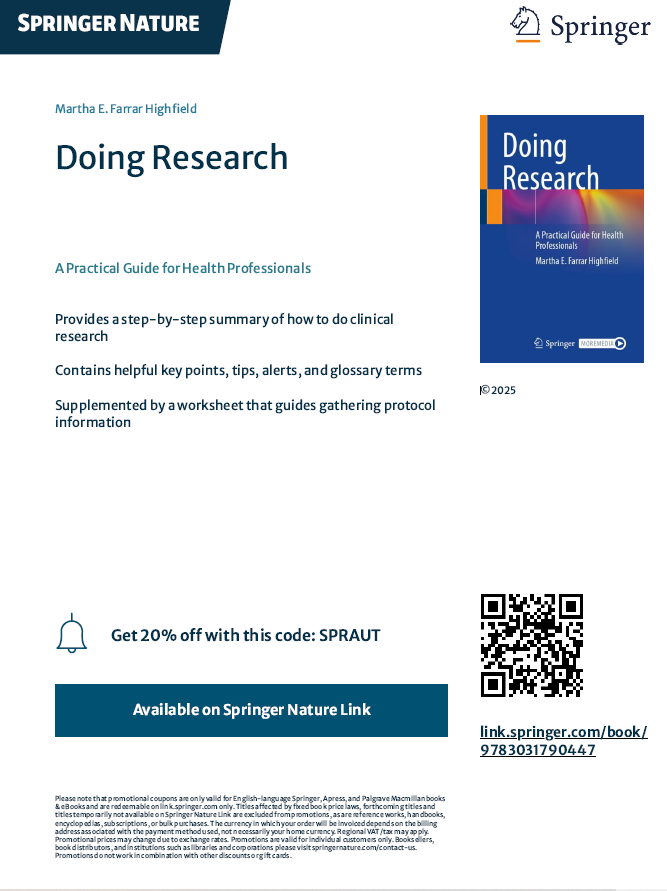
My 2025 book, Doing Research, is a user-friendly guide, not a comprehensive text. Chapter 1 gives a dozen tips to get started, Chapter 2 defines research, and Chapters 3-9 focus on planning. The remaining Chapters 10-12 guide you through challenges of conducting a study, getting answers from the data, and sharing with others what you learned. Italicized key terms are defined in the glossary, and a bibliography lists additional resources.
AI is getting better at 1) organizing information & 2) making suggestions for planning and writing research.
1st—a word of warning: Always verify AI-generated contentUSING YOUR OWN KNOWLEDGE!!Otherwise you’ll likely have AI hallucinations–content that is wrong, deceptive, or just plain nonsense. Scary!
Marek Kiczkowiak (speaker in below video) gives the AI-research-assistant gold medal to SCISPACE. AI SCISPACE bills itself as “The Fastest Research Platform Ever: All-in-one AI tools for students and researchers.” It performs a host of tasks, including creating slides from your paper. Other AI tools, like jenni or ResearchRabbit do some things better or differently. Watch this informative video, & try the tools.
What ethics questions does this raise? Two are: 1) questions of plagiarism (stealing) and 2) questions of how much YOU are learning when being AI-assisted.
Publishers are beginning to ask authors to what extent (if any) AI was used in a submitted paper. Moreoever, caution about plagiarizing is a cheap price for a clean conscience & learning what you need to learn. Hang onto those outcomes. “Above all else, guard your heart, for everything you do flows from it” -Proverb 4:23.
Here’s a second video for some help on avoiding plagiarism.
Your thots?
———————————————————–
Also, check out my 2025 bookDoing Research (~100pp) that is written to help make the difficult simple.
[Best place to purchase now is this link: Springer. Amazon is stocking it erratically for reasons mysterious to the publisher.]
Practical, brief, and affordable,Doing Research is for residents, nurses, chaplains, and other clinicians.
Written in informal, friendly style, this book makes the difficult simple.
The purpose of Doing Researchis to empower curious clinicians to conduct research alongside a mentor, even when they lack prior research experience or formal training.
Doing Research presents practical steps for conducting a study from beginning to end. It begins with “a dozen tips” to get started, then moves to study planning, conduct, and dissemination of results. A worksheet to write your research plan (protocol) is included. Research terms and process are explained, including what research is and is not. Tips & Alerts provide a “reassuring voice,” as well as alerting readers to common missteps.
UVA Bjoring Center for Nursing History Forum”Narrating a Life of Care: Hindsight, Omission, and Ambiguities of Interpretation in the History of Religion and Health”
Angela Xia October 24, 2023
12 p.m. (ET) on Zoom
Hosted by the UVA Bjoring Center for Nursing Historical InquiryZoom link: : https://virginia.zoom.us/j/93585126052?pwd=YzBxZ0V3ZGd2ZElvSGpTWWUxZ0V5Zz09 Meeting ID: 935 8512 6052 Passcode: 590924 Doctoral candidate Angela Xia will share findings from her dissertation research on religion, aging, and end of life care in the modern U.S., focusing on the lives of three women of color in the fields of elder and palliative health. In addition to their professional roles as health-care practitioners, what makes these three women — nurse Dr. Rita Kathleen Chow, palliative social worker Dr. Bernice Catherine Harper, and hospice oncologist Dr. Josefina Bautista Magno — distinct are the self-proclaimed connections between their religious identities and their philosophies of care, connections established in self-narrated sources such as memoir, autobiography, interviews, or reminiscences from colleagues and friends. What can such sources tell historians of religion and medicine about the relationship between a care practitioner’s religious subjectivity and their work? What effects do phenomena such as hindsight, omission, recalcitrance, devotion, or revision have on how such relationships are depicted? With such questions in hand, Angela’s talk will explore what it means to narrate a life of care with care.
Angela Xia is a scholar of religion and health in the modern U.S. and a Ph.D. candidate in the Department of Religious Studies at the University of Pennsylvania. Her dissertation, “The Rest of Life: Care and Aging in American Churches, 1970-2000,” offers the first historical account of how American religious leaders, educators, and care providers took up age as a matter of shared concern in the latter half of the 20th century. Her research has been supported by the Barbara Bates Center for the Study of the History of Nursing, the Bjoring Center for Nursing Historical Inquiry, and the Consortium for the History of Science, Technology, and Medicine.
We hope you can join us! Maura Singleton Center Manager Eleanor Crowder Bjoring Center for Nursing Historical Inquiry
Enrolled in an MSN….and wondering what to do for an evidence-based clinical project?
Recently a former student contacted me about that very question. Part of my response to her is below:
“One good place to start if you are flexible on your topic is to look through Cochrane Reviews, Joanna Briggs Institute, AHRQ Clinical Practice Guidelines, or similar for very strong evidence on a particular topic and then work to move that into practice in some way. (e.g., right now I’m involved in a project on using evidence of a Cochrane review on the benefits of music listening–not therapy–in improving patient outcomes like pain, mood, & opioid use).
Once you narrow the topic it will get easier. Also, you can apply only the best evidence you have, so if there isn’t much research or other evidence about the topic you might have to tackle the problem from a different angle” or pick an area where there IS enough evidence to apply.
Musings: For me the most difficult to write sections of a research report are the Intro/Background and Discussion. And yet, those are apparently the easiest to read for many. My students at least tend to read only those sections and skip the rest.
Why? For the author, Intro/Background and Discussion require hard, critical thinking about what is already known about the topic (Intro/Background) and then what one’s findings mean in light of that (Discussion). For research consumers, the language used in these sections is more familiar, ordinary sounding words. On the other hand, writing the technical nature of other sections (Methods, Instruments, Results) is pretty straightforward with scientifically standardized vocabulary and structure. But, for readers, those same sections contain potentially unfamiliar research terminology that is not part of everyday conversation– i.e., scientific vocabulary. Quantitative studies often create more reader difficulty.
My solution for myself as a writer? To spend time making sure that the first sentence of every paragraph in Intro/Background and Discussion makes a step-by-step argument supported by the rest of the paragraph. Follow standardized structure for the rest. Keep language precise yet simple as possible.
Solution for research readers? Read the whole article understanding what you can and keep a research glossary handy (e.g., https://sites.google.com/site/nursingresearchaid/week-1. Even if practice doesn’t make you perfect, it works in learning a new language–whether it is a ‘foreign’ language or a scientific one.
Critical Thinking: Test out your reading skills with this article https://www.ncbi.nlm.nih.gov/pmc/articles/PMC6503597/ . Do the authors make systematic arguments in Intro/Background & Discussion? What makes this article hard or easy to read?
I’m not a New Year’s resolution person. I used to be and then I realized that I wanted to hit the restart button more often than every 365 days. So…my aim for this blog remains pretty much unchanged: Make research processes and ideas understandable for every RN.
Although “to be simple is difficult,” that’s my goal. Let me know what’s difficult for you in research, because it probably is for others as well. Let’s work on the difficult together so that you can use the BEST Evidence in your practice.
The 2019 journey begins today, and tomorrow, and the tomorrows after that!
FOR MORE: Go to PubMed. Search for a topic of interest. Send me the article & we’ll critique together.
Want to know how to write an introduction/background section of a paper? Pay attention to STRUCTURE & evidence-based ARGUMENT in order to DIY (do-it-yourself) your own intro/background for a school paper or research report!
Focus only on the INTRO/BACKGROUND section for now. Check out the STRUCTURE then the EVIDENCE-BASED ARGUMENT of the Intro/Background. This is how you should write your own.
STRUCTURE of INTRO/BACKGROUND in Sørbø et al. (2015):
Where is the Intro/Background section located in the article?
What heading is used for the section?
Where are the research questionslocated in the Intro/Background? (HINT: this is the standard place in all papers & in this case the authors call them “aims.)
ARGUMENTS in INTRO/BACKGROUND in Sørbø et al. (2015):
Look at the first (topic) sentence of each paragraph in INTRO/BACKGROUND & listen to the systematic argument the researchers are making for WHY their study is important.
“Breast feeding has long been acknowledged as the optimal infant nutrition conferring beneficial short-term and long-term health effects for both infants and mothers.1–5 …
Abuse of women is common worldwide, as one in three women during lifetime suffer partner or non-partner abuse.10…Adverse effects [of abuse]… are barriers to breast feeding.*…
Given the overwhelming evidence of the positive effects of breast feeding, knowledge about factors influencing breastfeeding behaviour is essential….
We explored the impact of abuse of women on breastfeeding behaviour in a large prospective population in Norway where the expectations to breast feed are high, and breast feeding is facilitated in the work regulations….” (pp. 1-2)
Now look at the research & other evidence written down AFTER each of above key sentences that SUPPORT each idea.
Notice that the INTRO/BACKGROUND is NOT a series of abstracts of different studies!! Instead evidence is grouped into key arguments for the study: Breast feeding is best, Abuse is common, Abuse creates barriers to breastfeeding, & Therefore, knowing about factors affecting breastfeeding is important). [Note: Of course, if your particular professor or editor asks you to do a series of abstracts, then you must, but do group them in arguments like the topic sentences.]
All this leads naturally, logically to …(drum roll please!)…the research questions/hypotheses, which are the gaps in our knowledge that the research will fill. This sets up the rest of the research article!
Critical Thinking: Your turn! Write your own Intro/Background using
Structure:Placement in article, heading, placement of research question/hypothesis
Argument:Key idea topic sentences (make a list 1st) with supporting research & other evidence (your literature review).










 Although “to be simple is difficult,” that’s my goal. L
 et me know what’s difficult for you in research, because it probably is for others as well. Let’s work on the difficult together so that you can use the BEST Evidence in your practice.