In March 2026, I visited with nursing and midwifery faculty at Heritage Christian University in Ghana, and we discussed potential research ideas that they might develop into full studies.
Perhaps you want to brainstorm ideas as well. One way to get started is simply to check out examples of what others are doing. Those examples showcase peer-reviewed, funded projects–a sign of importance of the ideas–that may dovetail with your own interests.
Notice that some of those studies are simply large observational or descriptive research! Those are easier to do than intervention studies, and at the same time they make important contributions to our knowledge.
Happy research idea hunting!!
p.s. I’ll come back to a discussion of criterion related validity soon. Stay tuned.
[note: bonus 20% book discount from publisher. See below flyer]
My 2025 book, Doing Research, is a user-friendly guide, not a comprehensive text. Chapter 1 gives a dozen tips to get started, Chapter 2 defines research, and Chapters 3-9 focus on planning. The remaining Chapters 10-12 guide you through challenges of conducting a study, getting answers from the data, and sharing with others what you learned. Italicized key terms are defined in the glossary, and a bibliography lists additional resources.
This book provides a step-by-step summary of how to do clinical research. It explains what research is and isn’t, where to begin and end, and the meaning of key terms. A project planning worksheet is included and can be used as readers work their way through the book in developing a research protocol. The purpose of this book is to empower curious clinicians who want data-based answers.
Doing Research is a concise, user-friendly guide to conducting research, rather than a comprehensive research text. The book contains 12 main chapters followed by the protocol worksheet. Chapter 1 offers a dozen tips to get started, Chapter 2 defines research, and Chapters 3-9 focus on planning. Chapters 10-12 then guide readers through challenges of conducting a study, getting answers from the data, and disseminating results. Useful key points, tips, and alerts are strewn throughout the book to advise and encourage readers.
Research is using the scientific process to ask and answer questions by examining new or existing data for patterns. The data are measurements of variables of interest. The simplest definition of a variable is that it is something that varies, such as height, income, or country of origin. For example, a researcher might be interested in collecting data on triceps skin fold thickness to assess the nutritional status of preschool children. Skin fold thickness will vary.
Research is often categorized in different ways in terms of: data, design, broad aims, and logic.
Qualitative Data
Data. Studies that use numerical data to measure variables are called quantitative research. The Results section will be full of numbers! In contrast, other studies use word data to describe the nature of something, and these are called qualitative research (e.g., what words and ideas did person use to describe their experiences as part of a grief group). Qualitative results include themes. Research that uses both types of data in the same study is called mixed methods research (e.g., Meaning Making After the Loss of One’s Child).
Design. Study design is the overall plan for conducting a research study, and there are three basic designs: descriptive, correlational, and experimental.
Descriptiveresearch attempts to answer the question, “What exists?” It tells us what the situation is, but it cannot explain why things are the way they are. e.g., How much money do nurses make?
Correlational research answers the question: “What is the relationship” between variables (e.g., age and attitudes toward work). It cannot explain why those variables are or are not related. e.g.,relationship between nurse caring and patient satisfaction
Experimental research tries to answer “Why” question by examining cause and effect connections. e.g., gum chewing after surgery speeds return of bowel function. Gum chewing is a potential cause or “the why”
Aims. Studies, too, may be either applied research or basic research. Applied research is when the overall purpose of the research is to uncover knowledge that may be immediately used in practice (e.g., whether a scheduled postpartum quiet time facilitates breastfeeding). In contrast, basic research is when the new knowledge has no immediate application (e.g., identifying receptors on a cell wall).
Logic. Study logic may be inductive or deductive. Inductive reasoning is used in qualitative research; it starts with specific bits of information and moves toward generalizations [e.g., This patient’s pain is reduced after listening to music (specific); that means that music listening reduces all patients pain (general)]. Deductive reasoning is typical of quantitative research; it starts with generalizations and moves toward specifics [e.g., If listening to music relaxes people (general), then it may reduce post-operative pain (specific)]. Of course the logical conclusions in each case should be tested with research!
WHAT RESEARCH IS NOT:
Research as a scientific process is not going to the library or searching online to find information. It is also different from processes of applying research and non-research evidence to practice (called Evidence-Based Practice or EBP). And it is not the same as Quality Improvement (QI). See Two Roads Diverged for a flowchart to help differentiate research, QI and EBP.
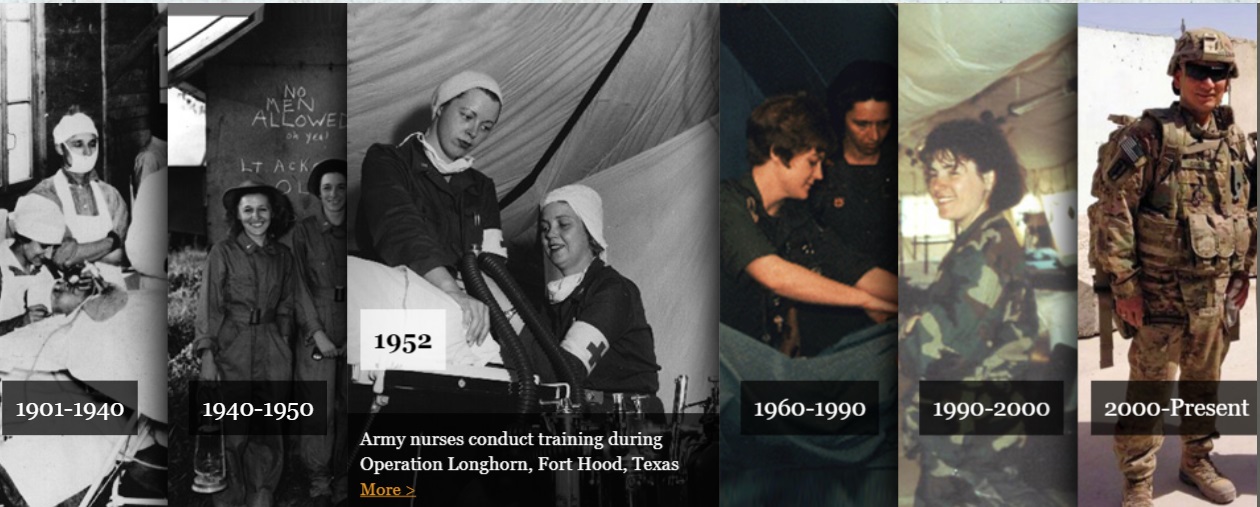
You can be a part of documenting such stories, including your own. Can I pique your interest with these examples about historical research?
1. Artifacts:Example = http://acif.org/The American Collectors of Infant Feeders:
CREDIT http://acif.org/
The American Collectors of Infant Feeders is a non-profit organization whose primary purpose is to gather and publish information pertaining to the feeding of infants throughout history. The collecting of infant feeders and related items is promoted.
2. Interviews:Example = http://www.oralhistory.org/ Want to do interviews of interesting faculty, students, leaders, “ordinary” nurses? Check out the Oral History Association In addition to fostering communication among its members, the OHA encourages standards of excellence in the collection, preservation, dissemination and uses of oral testimony.
3. Stories from the “ordinary:” Example: http://www.murphsplace.com/mother/main.htmlMy Mother’s War – “Helen T.Burrey was an American nurse who served as a Red Cross Nurse during World War I. She documented her experience in both a journal and a scrapbook which has been treasured by her daughter, Mary Murphy. Ms Murphy has placed many of these items on the Internet for people to access and it provides a first-hand account of that experience. Additionally she has a variety of links to other WWI resources.” (quoted from AAHN Resources online)
CREDIT http://e-anca.org/
4. Ethnic studies:Example=https://libguides.rowan.edu/blacknurses Black Nurses in History “This is a ‘bibliography and guide to web resources’ from the UMDNJ and Coriell Research Library. Included are Mamie O. Hail, Mary Eliza Mahoney, Jessie Sleet Scales, Mary Seacole, Mabel Keaton Staupers, Susie King Taylor, Sojourner Truth, Harriet Tubman.” (quoted from AAHN Resources online)
Critical thinking: Don’t forget to save your own materials. Your life is history! What in your life is most interesting? Have you written it down or dictated it into your iphone voice memo? There is GREAT interest in “ordinary” men and women. Many times items are tossed because they are “just letters” or “only old records,” or “stuff.” Just Don’t Do It.
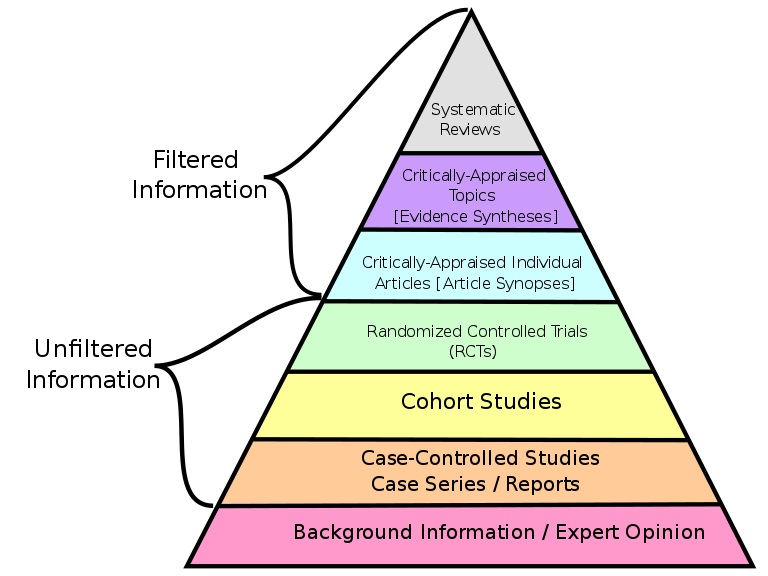
Last post I commented on the potentially misleading terms of Filtered & Unfiltered research. My key point? Much so-called “unfiltered research” has been screened (filtered) carefully through peer-review before publication; while some “filtered research” may have been ‘filtered’ only by a single expert & be out of date. If we use the terms filtered and unfiltered we should not be naive about their meanings. (Pyramid source: Wikimedia Commons )
This week, I address what I see as a 2nd problem with this evidence based medicine pyramid. That is, missing in action from it are descriptive, correlation, & in-depth qualitative research are not mentioned. Where are they? This undercuts the EBM pyramid as a teaching tool and also (intentionally or not) denigrates the necessary basic type of research on which stronger levels of evidence are built. That foundation of the pyramid, called loosely “background information,” includes such basic, essential research.
You may have heard of Benner’s Novice to Expert theory. Benner used in-depth, qualitative interview descriptions as data to generate her theory. Yet that type of research evidence is missing from medicine’s pyramid! Without a clear foundation the pyramid will just topple over. Better be clear!
I recommend substituting (or at least adding to your repertoire) anEvidence Based NURSING (EBN)pyramid. Several versions exist & one is below that includes some of the previously missing research! This one includes EBP & QI projects, too! Notice the explicit addition of detail to the below pyramid as described at https://www.youtube.com/watch?v=MfRbuzzKjcM.
For new graduate RNs (& those who help them) entering the workforce, Dr. Pat Benner PhD RN FAAN, who wrote Novice to Expert, has some great, very practical advice: https://www.youtube.com/watch?v=yxsBVPxS_zg (1:56) (hint: Remember the only behavior you can control is your own!)
And…it’s pretty good advice for any who assume a new job, too!
Critical Thinking: Whether or not you are a new grad, did you have experiences similar to those in Hussein’s study? Can you use Benner’s suggestions to deal with the issues?
There are several ways to classify types of research. One way is qualitative versus quantitative–in other words, WORD vs. NUMBER data, methods, & analysis.
Qualitative research focuses on words (or sometimes images) and their meanings.
Quantitative research focuses on numbers or counting things and statistical analysis that yields probable meaning.
If you watch this short, easy-to-understand youtube clip, you’ll have all the basics that you need to understand these! Enjoy!
Researchers collect two types of data in their studies
Numbers (called quantitative data)
Words & narratives (called qualitative data)
One source of rich word or narrative (qualitative) data for answering nursing questions is nurses’ stories. Dr. Pat Benner RN, author of Novice to Expert explains two things we can do to help nurses fully tell their stories so we can learn the most from their practice.
Listen well without interrupting
Help nurses ‘unpack’ their stories
Check out this excellent 2:59 video of Dr. Benner’s and revolutionize how you learn about nursing from nursing stories: Preview: The use of Narratives
Critical thinking: For a study using narratives in research see Leboul et al. (2017). Palliative sedation challenging the professional competency of health care providers and staff: A qualitative focus group and personal written narrative study. [full text available thru PubMed at https://www.ncbi.nlm.nih.gov/pubmed/28399846]. 1) Do you think the authors listened and unpacked information from the focus groups & written narratives; 2) Do you think there might be a difference in the way people write narratives and verbally tell narratives? 3) How might that difference if any affect the research findings?
Key point! The data collection section of a research article includes: who collects what data when, where & how.
In previous blogs we’ve looked at title, introduction, and other elements of methods section (design, sample, & setting). In this one let’s take a look at data collection.
Data are a collection of measurements. For example, student scores on a classroom test might be 97, 90, 88, 85, & so on. Each single score is a datum; collectively they are data.
What data are collected is answered in this section. The data (or measurements) can be numbers OR words. For example, numbers data might include patient ratings of their pain on a 0-10 scale. An example of word data would asking participants to describe something in words without counting the words or anything else. For example, word data might include patient descriptions pain in words, like “stabbing,” “achy,” and so on. Sometimes a researcher collects both number and word data in the same study to give a more complete description. You can see how knowing the patient’s pain rating and hearing a description would give you a much clearer picture of pain.
Studies reporting data in numbers are called quantitative studies
Studies reporting data in words/descriptions are called qualitative studies
Studies reporting number & word data are called mixed methods studies
How the data are collected includes what instrument or tool was used to gather data (e.g., observation, biophysical measure, or self-report) and how consistently & accurately that tool measures what it is supposed to measure (e.g., reliability & validity). Also included is who collected the data and the procedures that they followed—how did they obtain consent, interaction with subjects, timing of data collection and so on.











 research. My key point? Much so-called “unfiltered research” has been screened (filtered) carefully through peer-review before publication; while some “filtered research” may have been ‘filtered’ only by a single expert & be out of date. If we use the terms filtered and unfiltered we should not be naive about their meanings. (Pyramid source:
  You may have heard of Benner’s Novice to Expert theory. Benner used in-depth, qualitative interview descriptions as data to generate her theory. Yet that type of research evidence is missing from medicine’s pyramid! Without a clear foundation the pyramid will just topple over. Better be clear!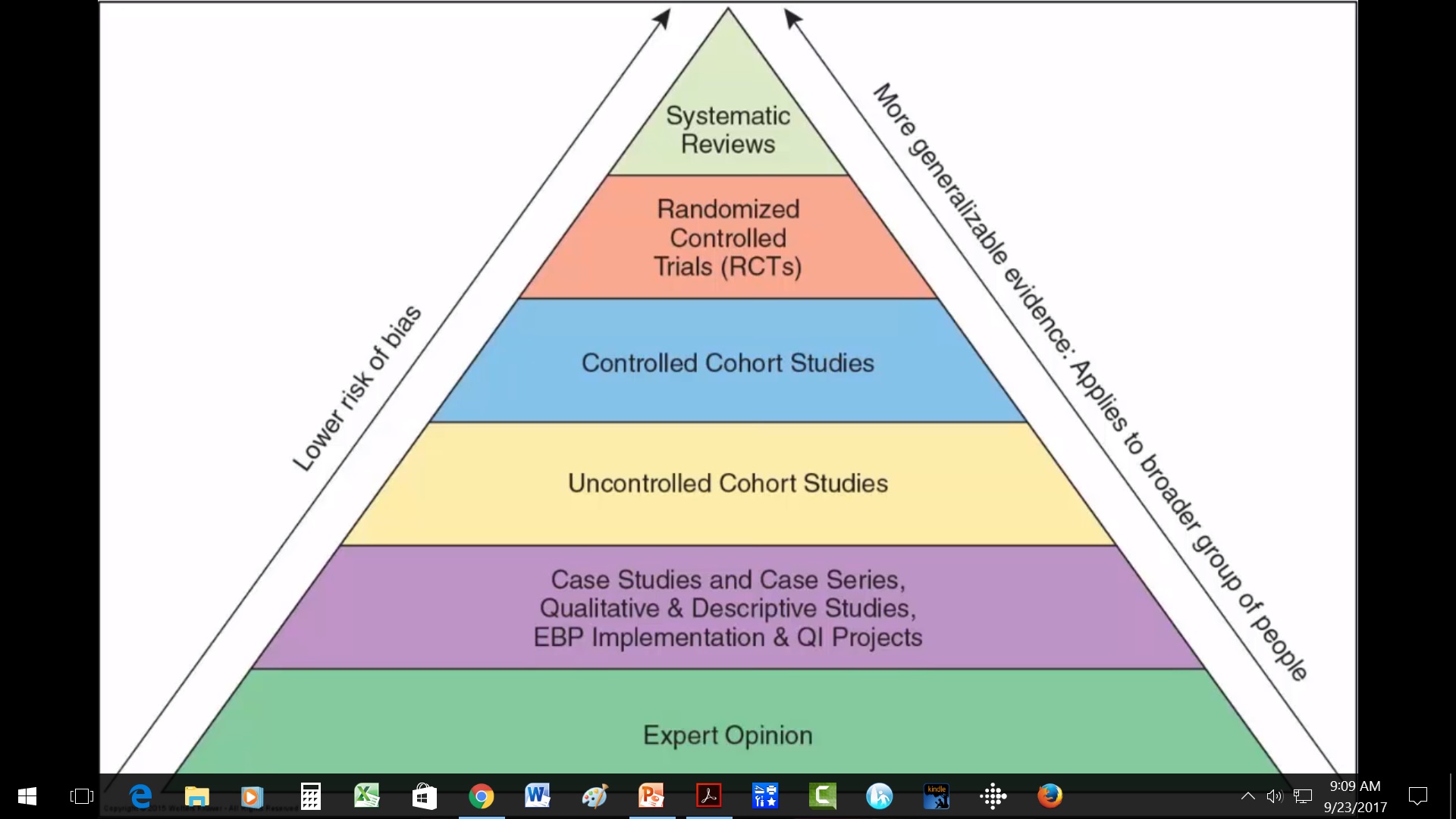




 One source of rich word or narrative (qualitative) data for answering nursing questions is nurses’ stories. Dr. Pat Benner RN, author of Novice to Expert explains two things we can do to help nurses fully tell their stories so we can learn the most from their practice.
 numbers OR words. For example, numbers data might include patient ratings of their pain on a 0-10 scale. An example of word data would asking participants to describe something in words without counting the words or anything else. For example, word data might include patient descriptions pain in words, like