All posts by Martha "Marty" Farrar Highfield PhD RN

It is difficult to be simple! Research can be understood when explained well. That's my aim.

Finding the Needles in the Haystacks: Evidence Hunting Efficiently & Effectively

Searching for the right evidence is an art & a science.   In an effective search, the RN: twoOnComputer

  1. Identifies excellent key words based on a clear problem statement
  2. Systematically searches the best databases for those words
  3. Keeps a record of the search strategy.

This is actually a pretty simple time-saver because it keeps you from having to repeat searches because you can’t remember where you looked!!

Let’s take an example that we used previously.  Here’s how it was laid out in PICO (which stands for Population/problem, Intervention, Comparison intervention, & Outcome)

  • Population/problem= Postoperative patients with ileus (Patient population &Problem)
  • Intervention= Gum chewing postop (Intervention to try out)
  • Comparison intervention= NPO with gradual diet progression when bowel sounds start returning
  • Outcome= Reduce time of postop ileus with sooner return to nutritious eating

We would:magnifyingGlass

  1. Using PICO, identify key concepts (words), such as “postoperative ileus” “gum chewing” and “NPO.” Note that you can pick single words or combinations of words.
  2. Search for this set of words in the very comprehensive databases of PubMed and also in CINAHL. CINAHL is more nursing specific, and PubMed is one of the most comprehensive out there. Search from MOST RECENT to earlier.  Go for only most recent 5 years unless 5 years doesn’t give you enough articles.
  3. Keep notes of exactly which words and phrases you used to search each database

This 5 minute video shows you a GREAT way to make sure that your search is complete with minimal effort. It’s an easy-peasy tracking strategy for where you’ve already looked. https://www.youtube.com/watch?v=233DzkmimV4&list=PLE3A977BE32CF3956

CRITICAL THINKING: What are the key words of your clinical problem of interest.  (You can choose to use PICO or not.)  Plug them into PubMed.  Did you get enough articles?QUESTION

Does Data Drive you Dotty? Then watch this!

Does the very idea of looking at data make your eyes cross and set your teeth on edge?EyesCrossed

If so, I have the solution for you!!   And you DO need a solution because Data–>Information–>Best Practices.

You might be surprised that in less than 10 minutes John Hicks at https://www.youtube.com/watch?v=–r9_R60Jws will have you able to describe the basic approach to data.   He gives you 4 key steps & builds from there.HappyFaces

I promise: No eyes glazing over. No getting lost in numbers and calculations. No problem. Don’t worry; be happy.

LearningI can feel it.  Your research reading skills have gone up a notch!  (And for those of you who are masters of data & analysis, enjoy this link for teaching others.)

For more Info: Watch his great follow-up, short, & sweet videos for more on statistics.

CRITICAL THINKING: First watch the video above—click here if you didn’t yet do that. Second outline the 4 steps using the abstract below. Third, answer these questions: Are the data quantitative or qualitative? Are the data are continuous or discrete? Are the data are primary or secondary?

Anjdersson, E.K., Willman, A., Sjostrom-Strand, A. & Borglin, G. (2015). Registered nurses’ descriptions of caring: A phenomenographic interview study. BMC Nursing. doi: 10.1186/s12912-015-0067-9

“Background: Nursing has come a long way since the days of Florence Nightingale and even though no consensus exists it would seem reasonable to assume that caring still remains the inner core, the essence of nursing. In the light of the societal, contextual and political changes that have taken place during the 21st century, it is important to explore whether these might have influenced the essence of nursing. The aim of this study was to describe registered nurses’ conceptions of caring. Methods: A qualitative design with a phenomenographic approach was used. The interviews with twenty-one nurses took place between March and May 2013 and the transcripts were analysed inspired by Marton and Booth’s description of phenomenography. Results: The analysis mirrored four qualitatively different ways of understanding caring from the nurses’ perspective: caring as person-centredness, caring as safeguarding the patient’s best interests, caring as nursing interventions and caring as contextually intertwined.  Conclusion: The most comprehensive feature of the nurses’ collective understanding of caring was their recognition and acknowledgment of the person behind the patient, i.e. person-centredness. However, caring was described as being part of an intricate interplay in the care context, which has impacted on all the described conceptions of caring. Greater emphasis on the care context, i.e. the environment in which caring takes place, are warranted as this could mitigate the possibility that essential care is left unaddressed, thus contributing to better quality of care and safer patient care.” [quoted from http://www.ncbi.nlm.nih.gov/pubmed/25834478]


“Who’s in?” Sampling Made Simple

So many great resources are out there at your fingertips.   In the next few blogs, I’ll point you to some of them.Heart Books

If you have not yet discovered the hidden jewel of the tab, “Research Made Simple,” on the Evidence-Based Nursing website at http://ebn.bmj.com/ , you should check out its full text pdf articles. An especially nice resource if you are in graduate school or maybe even a BSN course on research.

Here is a sample of one from June 9, 2014 of the population of articles at EBN.

ball sample“Sample selection is a key factor in research design and can determine whether research questions will be answered. …It is critical to take the time to clearly identify the population of interest for the specific research question. Nursing researchers are usually interested in answering questions about very specific patient populations which can span an incredible array of possibilities applying to international, national, local and organisational contexts. Research populations closely reflect nursing specialties, some of which are gender (eg, pregnant women) and age specific (eg, adolescent diabetes). It is rarely feasible to conduct a study that reaches every patient in the population of interest, therefore a subset or sample of that population is selected for study.” (para 1-2 Retrieved from http://ebn.bmj.com/content/17/2/32.short?g=w_ebn_research_tab ) [note: I added the bold]

I invite you to use the comments section to post URLs for other great sites!

Critical Thinking: Read the previous blog on representatives & then QUESTIONdecide for yourself whether this single EBN article on sampling is representative of clear & simple explanations. Samples can be things, not just people. What questions should you ask me about my sampling procedure?

For More: Check out tab “Research Made Simple,” on the Evidence-Based Nursing website at http://ebn.bmj.com/ .   OR try this <5 minute simple sampling youtube video  https://www.youtube.com/watch?v=Gs-gLeYuDZw

“That is so random!” But is it Representative?

What makes a good sample in research?  One thing.  And it isn’t random selection.  (Surprised?)

Portrait of a diversity Mixed Age and Multi-generation Family embracing and standing together. Isolated on white background. [url=http://www.istockphoto.com/search/lightbox/9786738][img]http://dl.dropbox.com/u/40117171/group.jpg[/img][/url]It is representativeness.  No matter how the sample was picked, it must be representative of all those in the larger population, if the researcher wants to say anything about anyone who wasn’t in the study.  Now, of course, it is true that random selection is more likely to give you a representative sample, but it is no guarantee.  Only likely.

What is random sampling?  It is when every member of the larger population has an equal chance of being selected for the study sample.  Example? Drawing names out of a hat.  It is well-accepted practice to generalize research results from a random sample to others like those being studied (assuming that all other aspects of the study are strong).

In contrast a convenience (or nonprobability) sample is when some people are more likely to be chosen to be in the study than others.  You shouldn’t generalize the results of these studies because the samples may Not represent others.

Example of when random sampling doesn’t work: Let’s say you have a mixture of red, green, & yellow apples, and you select a sample that has only yellow apples.  (The red & green ones are going to be offended!–They’re left out.)  You now have a sample that is biased in favor of yellow apples!   Your sample does Not represent the larger population of apples…even if you used random methods to get it.  If you want to apply the study to red & green & yellow apples…well….you must get some of them in your sample, too. The yellow apples might not be at all like the other types and studying just yellow might mislead you into thinking something about the red & green ones that isn’t true!   Of course you could study all the millions of apples in the world and exclude none, but that would be pretty cumbersome and expensive.   So, it’s better to go for a representative sample!

When else doesn’t random sampling create a representative sample?   If I am doing historical research, say on the Nursing Department at California State University/Northridge, then I want to hand pick the specific RNs by name who were in charge of the Department from the beginning.  Randomly selecting nurses from those who worked at the University won’t represent those leaders.

QUESTIONCritical Thinking:  Take a quick look at the linked abstracts. How were the samples selected?  How representative are the samples of a larger population of interest?  Could you generalize the results to other people, and if so to whom?

Want more information on sampline? Check this out.  It takes < 5 minutes:

https://www.youtube.com/watch?feature=endscreen&v=be9e-Q-jC-0&NR=1

“The Sky is Falling!” (or Don’t be an EBP Chicken Little)

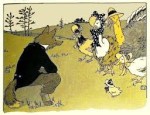
We all know the story of Chicken Little, right?  Chicken Little is walking through the forest, an acorn falls and hits her on the head, then Chicken Little  runs about in a panic telling everyone, “The sky is falling! The sky is falling!” A lot of the animals are convinced, and the fox—who knows the truth that it was only an acorn—convinces Chicken Little & some other animals to come into his den to be safe from the falling sky. There he eats them. Interestingly the fox used the correct evidence well. Chicken Little & fox chicken littlecompany used evidence poorly and created a safety hazard for themselves!

Moral of the story? Don’t be a Chicken Little when it comes to reading and applying research to practice. Get all the facts before you share the research findings with others. Don’t read only the “acorn” of abstract, introduction, and discussion, and then assume that you know what the research study shows and that you can apply it to your work. Don’t turn an acorn into a falling sky!

How to avoid being an EBP Chicken Little? To avoid being an Evidence-Based Practice (EBP) Chicken Little, you should follow the example of Samantha in this research fairy tale: “Samantha…read the study abstract. Then, while Chicken Little and her friends waited anxiously, she read the introduction, the literature review, the research questions, the methods section, the findings, and the discussion section. Then she went back and read all the sections again. Finally, as Chicken Little hopped around her impatiently, she reread the findings. “Chicken Little, have you and your friends read the entire study?” asked Samantha.” (source: https://www.son.rochester.edu/student-resources/research-fables/chicken-little.html)

Why go to all this trouble? I’m busy. The reasons to take time and effort to read the WHOLE study are many. First, the subjects may not be at all like your own patient population—what if the researchers studied only “left-pawed albino hamsters”? Second, the research might not be a strong meta-analysis or randomized controlled trial whose results can actually be applied to other times and places—what if the researchers just watched subjects walk around, but didn’t test what makes them walk better?  A third reason is that the results might be statistically significant, but clinically irrelevant!—what if researchers were studying pain, but everyone in the study had 1-2 on the pain scale?

You don’t want to endanger patient safety by misunderstanding and misapplying research and then be “eaten alive” by adverse patient outcomes or by critics, who will see through your mistakes. Remember in the fairy tale Chicken Little and his careless friends misunderstood the facts, and hence were susceptible to being eaten by a fox.

What if you don’t know how to read research? No problem. Everyone who knows how to read research now had to learn it—no one was born knowing.  So,…you can learn it, too!  It doesn’t take magical powers.  Countless resources are online; others are in your hospital or in a university research course. If you check the box on this page to follow the EBP blog, (I hope) it will help, too. Go back and read earlier blogs on sections of a research report.

For more information on how to be an EBP Chicken Little (NOT) see the very creative research fairy tale by Jeanne Grace (copyright Rochester College) at https://www.son.rochester.edu/student-resources/research-fables/chicken-little.html

Critical thinking:

  1. After reading Grace’s fairy tale at the above link list at least three (3) things that Chicken Little might have learned, had she read the whole article!
  2. Compare an abstract with a full article, and check out the differences. Specifically compare the abstract at  http://www.ncbi.nlm.nih.gov/pubmed/2606078 with what you learn about them from the full article at http://www.ncbi.nlm.http://www.ncbi.nlm.nih.gov/pubmed/2606078nih.gov/pmc/articles/PMC4449996/. Did reading the whole article change the way you understand how orQUESTION whether the study might apply to your work? If so, how? And if not, why not?

Ask King Charles II: “Why do we need evidence-based practice?”

Want to know the value of evidence in practice?  You might ask King Charles II (or at least his physicians who survived him).   Check out what happens when much of the evidence for practice was based on tradition & experts: https://www.youtube.com/watch?v=OeA_OKqqBJ4 (5:27).

Everyone agrees…..patients deserve the best care we can give now, even though we won’t know everything about anything until we know everything about everything (RCH personal communication)

Critical thinking:  What is one practice that you learned in nursing school, that has already changed?   Why did it change?QUESTION

For some evidence that you can probably put to use right away to give patient-centered, family-centered care, check out this user friendly summary from UCSD! https://www.youtube.com/watch?v=Q_hs-uNBdPQ (4:48)

“Is it?” “It is!” Expert opinion as valuable evidence for practice.

“Is it?” “It is!” Expert opinion as valuable evidence for practice..

“Is it?” “It is!” Expert opinion as valuable evidence for practice.

Remember back when you asked your mom why you should make your bed, set the table, or do some other then-distasteful task? Maybe you said, “Do I have to?”

Because I Said SoRemember her answer? Sometimes it was just: “Because I said so!” Was that enough evidence to support your practice of setting the table or making your bed?  You bet! After all she was THE expert on such things.

Likewise…is expert opinion good evidence for your practice? Yes, it is. EXPERT OPINION of individuals or committees is the 7th level of evidence for nursing practice (Melnyk & Fineout-Overholt, 2005), and should be considered.

Of course the first question that you must ask is: “Is the person/committee (who is telling you how to prevent falls, promote safety, teach patients, and so on and on) an actual EXPERT on that topic?” The answer is a matter of judgment. If the person/committee has special education, credentials, or experience or is a recognized authority on the topic about which they are giving advice, then you could reasonably conclude yes, they are experts. In that case the advice should be considered evidence for practice.    (Caution: Your judgment of their expertise matters!–don’t just follow along.  Don’t forget that person who is expert in one area may not be an expert in another.)

The 2nd question that you must ask is; “Does any research or stronger level of evidence exist on the topic?”

  • If it does NOT exist, then you should use that expert opinion in combination with scientific principles, anecdotal case reports, and theory. Or you might create some new research yourself. (Source=Iowa EBP Model)
  • If it DOES EXIST, then you should pay most attention to the stronger evidence and interpret the weaker evidence of expert opinion in that light.

QUESTIONCritical thinking:  Try your new knowledge in this example. Many educators and professionals who run journal clubs consider journal clubs effective based on feedback from participants. At least in 2008, 80% of experimental studies suggested that journal clubs helped with learning and being able to critically review a research article. However, no research is available on whether the learning from journal clubs actually translates into practice (Deenadayalan et al., 2008). You are considering a journal club. What would you decide to do and why?

For more, see:

“What it is.” – a primer on descriptive studies

What is a “single descriptive or qualitative study”?

A single descriptive or qualitative study is a study in which the researcher watches and listens, then describes what s/he sees and hears. In these studies the researcher does NOT try out a new treatment and measure the results. The descriptive researcher only describes.

The description may be reported in:

  • Numbers & Statistics (called a quantitative study) OR
  • Words & Themes (called a qualitative study).

If the researcher reports BOTH numbers/statistics AND word/themes, it is called a mixed methods study.

Descriptive studies are listed as pretty weak evidence for changing practice, but remember that it is weak only in terms of Not being able to show that one event is causing another event.   They are still excellent in terms of describing what is.    (For more on strength of evidence refer back to: “I like my coffee—and my evidence—strong!)

CRITICAL THINKING: (sing with me) “One of theseQUESTION things is not like the other. One of these things just doesn’t belong. Can you guess which one is not like the other?” Two are descriptive studies. One is not.

  1. Thomas, D., et al., (2015). Pediatric Pain Management in the Emergency Department: The Triage Nurses’ Perspective. The aims of the study were to describe the triage pain treatment protocols used, knowledge of pain management modalities, and barriers and attitudes towards implementation of pain treatment protocols.
  2. Ucuzal & Dogan. (2015). Emergency nurses’ knowledge, attitude and clinical decision making skills about pain. The aim of this study was to examine emergency nurses’ knowledge, attitude and clinical decision-making skills about pain.
  3. Harrison et al., (2015). Sweet tasting solutions for reduction of needle-related procedural pain in children aged one to 16 years.  The aim of the study was to determine the efficacy of sweet tasting solutions or substances for reducing needle-related procedural pain in children beyond one year of age.

“Watch & Learn!” – Systematic Reviews of Non-experimental Studies

Today’s top tip: Want to find the strongest research evidence for your project?   Go to http://www.ncbi.nlm.nih.gov/pubmed & add the strongest type of research designs as one of your search terms. For example, add the terms meta-analysis or systematic review to your other search terms. **********************************************

Now to the new!  What is a systematic review of descriptive studies? [Note: For information on stronger levels of research “I like my coffee (and my evidence) strong!)]Cat Fishbowl2

First, remember that in a descriptive study, the researcher merely watches or listens to see what is happening. Descriptive studies do not test interventions.

Second, a systematic review (not to be too silly) is a review that is done systematically in order to include all literature on a particular topic . The authors will tell us where they searched for studies, what search terms they used, and what years they searched. That way we can feel sure that all relevant articles are included.

Therefore, in a systematic review of descriptive studies the authors

  • Collect non-experimental studies related to the problem they are trying to solve,
  • Critically review them, &
  • Write up that analysis for you and me.

You won’t see a lot of numbers or statistics in these reviews of non-experimental studies.

Systematic review of descriptive studies are weaker than other levels of evidence in part because they are critical reviews of non-experimental studies in which the researchers only observed subjects. Those non-experimental studies that they are reviewing may be quantitative with results reported in numbers or qualitative with results reported in words.

Here’s an example with results reported in words (qualitative): Yin, Tse, & Wong (2015) systematically reviewed studies for what factors affect RNs giving PRN opioids in the postop period.   They searched publications 2000-2012 and ended up with 39 relevant studies. Within those 39 articles were descriptive studies that identified 4 basic influences on opioid PRN administration by RNs to postop patients: “(i) nurses’ knowledge and attitudes about pain management; (ii) the situation of nurses’ work practices in administrating range orders for opioid analgesics; (iii) factors that influenced nurses’ work practices; and (iv) perceived barriers to effective pain management from the nurse’s perspective.” [note: In this study a few of the 39 studies were experimental in which something was done to subjects and then outcomes measured, and Yin et al., commented separately on what those showed.]

Critical thinking: What are key differences between a meta-analysis of randomized controlled trials and a systematic review of QUESTIONdescriptive studies?

Reference found with search terms: review of descriptive studies nursing pain – Yin, H.H.,Tse, M.M., & Wong, F.K. (2015). Systematic review of the predisposing, enabling, and reinforcing factors which influence nursing administration of opioids in the postoperative period. Japan Journal of Nursing Science, doi: 10.1111/jjns.12075.