Category Archives: Evidence based nursing

“Watch & Learn!” – Systematic Reviews of Non-experimental Studies

Today’s top tip: Want to find the strongest research evidence for your project?   Go to http://www.ncbi.nlm.nih.gov/pubmed & add the strongest type of research designs as one of your search terms. For example, add the terms meta-analysis or systematic review to your other search terms. **********************************************

Now to the new!  What is a systematic review of descriptive studies? [Note: For information on stronger levels of research “I like my coffee (and my evidence) strong!)]Cat Fishbowl2

First, remember that in a descriptive study, the researcher merely watches or listens to see what is happening. Descriptive studies do not test interventions.

Second, a systematic review (not to be too silly) is a review that is done systematically in order to include all literature on a particular topic . The authors will tell us where they searched for studies, what search terms they used, and what years they searched. That way we can feel sure that all relevant articles are included.

Therefore, in a systematic review of descriptive studies the authors

  • Collect non-experimental studies related to the problem they are trying to solve,
  • Critically review them, &
  • Write up that analysis for you and me.

You won’t see a lot of numbers or statistics in these reviews of non-experimental studies.

Systematic review of descriptive studies are weaker than other levels of evidence in part because they are critical reviews of non-experimental studies in which the researchers only observed subjects. Those non-experimental studies that they are reviewing may be quantitative with results reported in numbers or qualitative with results reported in words.

Here’s an example with results reported in words (qualitative): Yin, Tse, & Wong (2015) systematically reviewed studies for what factors affect RNs giving PRN opioids in the postop period.   They searched publications 2000-2012 and ended up with 39 relevant studies. Within those 39 articles were descriptive studies that identified 4 basic influences on opioid PRN administration by RNs to postop patients: “(i) nurses’ knowledge and attitudes about pain management; (ii) the situation of nurses’ work practices in administrating range orders for opioid analgesics; (iii) factors that influenced nurses’ work practices; and (iv) perceived barriers to effective pain management from the nurse’s perspective.” [note: In this study a few of the 39 studies were experimental in which something was done to subjects and then outcomes measured, and Yin et al., commented separately on what those showed.]

Critical thinking: What are key differences between a meta-analysis of randomized controlled trials and a systematic review of QUESTIONdescriptive studies?

Reference found with search terms: review of descriptive studies nursing pain – Yin, H.H.,Tse, M.M., & Wong, F.K. (2015). Systematic review of the predisposing, enabling, and reinforcing factors which influence nursing administration of opioids in the postoperative period. Japan Journal of Nursing Science, doi: 10.1111/jjns.12075.


Cohort & Case-controlled studies: Going forward & backward

Got a clinical problem?  You probably want to solve it with evidence—STRONG evidence.   Click on this link to see one well-accepted hierarchy from strongest #1 to weakest #7 (Melnyk & Fineout-Overholt, 2005).   Today let’s look at the 4th strongest level of evidence = Case controlled or cohort studies

First a quick review

Click here for a quick review of the strongest 2 levels of evidence (#1 Systematic reviews, Meta-analyses, or Evidence-based clinical practice guidelines based on systematic review of RCTs. #2 Randomized controlled trials)

Click here for a review of the 3rd strongest type of evidence (#3Controlled trials without randomization)

Now on to the new “stuff”  strong

All 3 of the top, strongest levels of evidence are experimental studies (or include available experimental studies). That means the researcher actually does something or gives a treatment to some of the subjects and then records the outcomes. 

The weaker 4 levels of evidence are non-experimental designs. This means that the researcher merely observes & does Not do anything to subjects. So how does that work?!

First, a cohort study (non-experimental). A cohort study starts with a group of people who have something in common and then the researcher observes only & keeps collecting data from them over a long time into the future. Data collection into the future is called a prospective study. An example is the Nurses’ Health Study, in which over 20,000 nurses were identified and followed-up annually with tests and surveys for over 25 years (this study is still ongoing). These studies provide very valuable information, but are obviously very expensive and time-consuming.”(OMERAD EBM course, 2008)

Now a case-controlled study (non-experimental).  In a case controlled study the researcher observes only & collects data over time into the past (not the future). Data collection into the past is called a imagesCAH6C8NTretrospective study. Again, from the OMERAD EBM (2008) site this example: “Patients with a disease are identified who have suffered a bad outcome such as death or recurrence, and compared with patients who have the disease but haven’t suffered the bad outcome. For example, a researcher might  identify a group of breast cancer patients who have died…, and compare them with a similar group of patients with breast cancer who are still living.”

Critical thinking: Which of these would be better for casQUESTIONe-controlled study and which for cohort study.

  1. You are a runner in the Los Angeles marathon and you are interested in how that race can improve cardiovascular health among those who finish. Question: Cohort or Case controlled?
  2. Some finishers of the LA marathon die of heart attacks 20 years later; many survive another 40 years.   Question: Cohort or Case controlled?

For more info see:


Of Mice and Cheese: Research with Non-equivalent Groups

Last week’s blog focused on the strongest types of evidence that you might find when trying to solve a clinical problem. These are: #1 Systematic reviews, Meta-analyses, or Evidence-based clinical practice guidelines based on systematic review of RCTs; & #2 Randomized controlled trials. (For levels of evidence from strongest to weakest, see blog “I like my coffee (and my evidence) strong!”)

So after the two strongest levels of evidence what is the next strongest? #3 level is controlled trials without randomization. (Sometimes called quasi-experimental studies.)

Here’s an example of a controlled trial without randomization: I take two groups of mice and test two types of cheese to find out which one mice like best. I do NOT randomly assign the mice to groups. The experimental group #1 loved Swiss cheese, & the control group #2 refused to eat the cheddar. I assume confidently that mice LOVE Swiss cheese & do NOT like cheddar. What’s the problem with my conclusion? If you want to know, then read on!swiss cheese

In my mouse Controlled Trial Without Randomization, the groups were formed by convenience and Not randomly assigned. Thus, any difference in outcomes between groups might be related to some pre-existing difference between groups. My outcome of mice loving Swiss & hating Cheddar might have nothing to do with the experimental treatment.   In fact, I did not know that all my mice in the Swiss cheese group #1 hadn’t eaten in 2 days, and my mice in the cheddar group #2 had just had a full lunch. Ooops.

On the other hand if I had randomly assigned all the mice to two groups, then I could be relatively confident that all little differences between group members were evenly distributed to both groups, so that the groups were equivalent. My two mouse-groups would have probably ended up with a pretty even distribution of both hungry and not-so-hungry mice.   Then if my Swiss cheese group devoured the Swiss and my cheddar group rejected the cheddar, I could be more certain that mice love Swiss and dislike cheddar.

Happy evidence hunting!

How to Re-Invent the Wheel (NOT!!)

You can avoid re-inventing the wheel by checking in with top notch wheelexperts who have already examined the practice problem that you face.

In other words, it’s time to head to the library. After all that’s what the library is: the experiences and research written down by experts, who have spent a lot of time thinking about the same problem that you are facing. Really it’s pretty amazing that we have access to health professionals all over the world who are eager to help you avoid re-inventing the wheel.imagesCAGYW6WB

The best experts in the field are talking directly to you through their publications!

Of course it’s important to ask your colleagues in your own and other institutions about their ideas on the problem, but that’s not enough. You will be limited by what they happen to know; or worse you will be limited by what they don’t happen to know! Nurses on your floor can provide practical, site-specific insights, but it’s easy to see why you would want to add newest information from the top experts. That is BEST evidence.

Remember: EBP = Best evidence + Clinical judgment + Patient/family preferences/values

HOW do you find the experts in the library?

  1. The first step is to identify KEY WORDS from your PICO.
  2. Use single words or put phrases in parenthesis in your list of words (e.g., “postoperative ileus”). A librarian can help with key words, too.
  3. Google the site PubMed (PubMed is a complete database of healthcare publications)
  4. In the search box at the top of the PubMed page, type in your key words
  5. You will get a list of articles on your topic (and some related articles on the right side)
  6. Click on the box beside the ones that you want & email that list tocomputers shaking hands your facility librarian with a request to pull the complete articles for you! (Of course if you are a student with some direct access to full-text articles in a school library, then it may be quicker to get them on your own. It’s up to you, but part of your “village that it takes” might be the librarian.) [See “Take five!” if you want more on to why PubMed beats Google Scholar.]

EXAMPLE: Let’s get specific….

  • Take this problem that we have discussed before:
    • P = Postoperative patients with ileus (Population or Problem)
    • I = Gum chewing postop (Intervention to try out)
    • C = NPO with gradual diet progression when bowel sounds start returning (Comparison intervention)
    • O = Reduce time of postop ileus with sooner return to nutritious eating (Outcome that you want)
  • What are some key words from the above PICO stated problem? “Postoperative ileus” adults “gum chewing”
  • Go ahead. Pull up PubMed. Paste in the key words You should get 11 articles about gum chewing & postoperative ileus. Check the boxes of the ones you want, then…
  • Click on the “SEND TO” link near the upper right corner of the screen and email the list to the librarian with a request for full-text of the articles. (You can send to yourself, too)
  • Congratulate yourself on an EBP literature search well-started!

CRITICAL THINKING: Why wouldn’t you simply use google.com to find expert opinions?  [If you want more “data”  related to this question.  Check out“Take five!”]

FOR MORE INFO: Check out this tutorial on how PubMed works & what’s in it http://www.nlm.nih.gov/bsd/disted/pubmedtutorial/020_010.html You pay for PubMed through your taxes—get your $$ worth!


It Takes a “Village”

BEST patient care results from using the best evidence in practice using your clinical judgment and the preferences and values of patients & families. In shorthand this is called evidence-based practice (EBP).

Most of the time it takes more than one person to bring evidence into practice.   Maybe not really a whole village,….but definitely anyone  who will be affected by the change OR whose cooperation you need to make the change!

team

In the last blog, we considered how to identify a problem clearly by using the acronym PICO.   Here was our example:

  • P = Postoperative patients with ileus (Patient population & Problem)
  • I = Gum chewing postop (Intervention to try out)
  • C = NPO with gradual diet progression when bowel sounds start returning (Comparison intervention—maybe the current protocol or highly varied individual RN expertise)
  • O = Reduce time of postop ileus with sooner return to nutritious eating (Outcome—what you want to happen!)  (For more on PICO check out last week’s post: “You Got a Problem with That? Try PICO)

The next BIG question: “Is the problem you have identified a PRIORITY?”

priority

  • Some priorities are triggered by problems—for example, your observation that something is not working, or poor PI outcome data, or below benchmark HCAHPS scores.
  • Others are triggered by new knowledge—for example, you read an   article, new research has come out, or your professional organization has new standards.

Now what? You need to gather your “village,” even if it’s only 2 people!!   Let’s say postoperative ileus is a BIG, PRIORITY problem on your unit, and you saw a research article on how gum chewing reduces time of postop ileus. Your next question is, “Who do I need to help reduce ileus by trying out gum chewing?” Well…your manager would certainly want to know, and the surgeon. Other patient-care RNs on the unit are critical to its success, too. And maybe you could use some help in finding and critiquing articles/evidence.

team

NO need to go it alone in solving the issue! Find others who care about the problem. Invite them & anyone (stakeholders) who would need to know about the postop gum chewing. The team can be 2 people if you like; or a lot more.

  • If you have a unit-based council, then you already have a pre-made team!
  • If you need to find some teammates, consider some of these people: a respected clinician with lots of respect; a new graduate with lots of energy; someone who loves to read research; & others.

Critical Thinking: Think of a clinical problem on your unit. Write it out in PICO format and list the names of those who would be on your problem-solving “village” team.  Whose cooperation do you need?

Want to read more? Melnyk, B.M., Fineout-Overholt, E., Stillwell, S.B., Williamson, & K. (2009). Evidence-Based Practice: Step by Step: Igniting a Spirit of Inquiry, American Journal of Nursing, 109(11), 49-52, doi: 10.1097/01.NAJ.0000363354.53883.58

You Got A Problem With That? Try PICO*

IF….

  • The Purpose of evidence-based practice (EBP) =  BEST PATIENT CARE, &
  • The Definition of EBP = Best evidence + Clinical judgment + Patient/Family preferences & values

THEN…How do I get started with EBP to improve patient care?

One of the 1st steps is to identify clearly the clinical issue that needs solving.   One way to do that is by using PICO.*

WHAT IS PICO?   PICO is an acronym to help you clarify the clinical problem & to help you prepare to search the literature for evidence

  • P = Patient population or problem
  • I = Intervention or treatment that you want to try out & is based in best evidence
  • C = Comparison intervention or treatment (This might be some standardized care on your unit; or un-standardized care given by individual nurses based on their individual expertise)
  • O = Outcome you want to achieve.

EXAMPLE:  Let’s say you work with post-op patients and want to speed up patients’ return of normal GI function.  Right now on your unit, patients are NPO post-op progressing to ice chips and so on as their bowel sounds start returning.  But you have 2 concerns: a) some patients’ GI function seems quite slow to return; & b) quicker return to a nutritious diet may speed healing.  You read an article that gum chewing can reduce the time of postoperative ileus.  With that information, here is how your PICO problem would look:

  • P = Postoperative patients with ileus
  • I = Gum chewing postop
  • C = NPO with gradual diet progression when bowel sounds start returning
  • O = Reduce time of postop ileus with sooner return to nutritious eating

CRITICAL THINKING: Now you try it.  What is problem for patients (or nurses) on your unit? Try writing it out in a sentence or two and then put it into PICO format.  You are now on your way with beginning an EBP project that will promote the very BEST PATIENT CARE.

*Note: Some use PICOT that includes “T”.  The “T” stands for the time it will take to show an outcome.  Because the timing does not seem to me relevant to all questions I typically omit it, but you may find it helpful.  If so, use it!


EBP: What’s the point? & What is it anyway?*

The next few blogs will focus on how to improve your nursing practice by finding & using the best evidence.

  • 1st– What is the point or goal of evidence-based practice (EBP)? Best patient care.
  • 2nd– What is the definition of Evidence based Practice (EBP)?

Evidence-based Practice (EBP) =

Best evidence(research &/or nonresearch) +

Clinical Expertise +

Patient/family preferences & values

(See http://guides.mclibrary.duke.edu/c.php?g=158201&p=1036021 for more.)

  • 3rd– What should I do step-by-step to use the best evidence in order to give BEST patient care? At Dignity NHMC we use the Iowa model as a step-by-step guide (Titler et al, 2001). (Other readers should check to see if their hospital has adopted a model that they should follow.)   NHMC employees can find a copy of the Iowa model reprinted with permission and other information at S:\Everyone\everyone\EVIDENCE BASED PRACTICE-RN Scientist Role.  Additionally NHMC employees can contact the nursing EBP/research facilitator at martha.highfield@dignityhealth.org or extension 3339 for questions or one-to-one help.
  • What is the general process of EBP?Most models include the following elements:
  1. Identify clearly the clinical issue that needs solving.Maybe this is a problem that you’ve encountered in your practice, or maybe it is something you heard about from a colleague or journal. For example, what is the best way to manage injection pain in children?
  2. Find the best evidence. Research is typically regarded as best evidence.  When no research has been done on the topic we can still use expert opinions, case studies, and scientific principles.
  3. Critique the strength of the evidence. This is figuring out how much confidence you have that the research studies are coming to the right conclusions.  If you’re not sure, an NP or CNS could help or point you to another mentor.
  4. Combine (synthesize) all evidence.When research study outcomes contradict each other, then we have to look at which studies are most carefully done.  Again an APN can help.
  5. Write clinical recommendations for your settingbased on best evidence+clinical expertise+patient/family values & preferences.
  6. Try out (or pilot) the clinical recommendationsin your setting using clinical judgment and patient/family preferences and values.
  7. Evaluate the outcomes.
  8. PRN “tweak” your recommendations to improve outcomes& roll out the project to other units if appropriate.
  9. Reinforce the “new & improved” evidence-based practiceso that it is sustained.
  10. Monitor outcomes.

CRITICAL THINKING:  What is one patient-care issue that you think can be improved on your unit?  For example: Reducing post-op ileus? Cutting down on nighttime noise on the unit? Dealing with nurses’ potential alarm fatigue?  Other?   Write the problem out.  Writing it out makes you think it through more clearly so don’t just think it—write it.  Then, STAY TUNED next blog for more on clarifying the problem.

Reference: Titler, M.G., Kleiber, C., Steelman, V.J., Rakel, B.A., Budreau, G., Everett, L.Q., Buckwalter, K.C., Tripp-Reimer, T., Goode, C.J. (2001) The Iowa Model of Evidence-Based Practice to Promote Quality Care. Critical Care Nursing Clinics of North America, 13(4), 497-509.

*The next few blogs will focus more on how to use research in practice (commonly known as Evidence-based Practice)

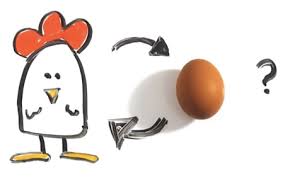
“Which Came 1st–The chicken or the egg?” (or, Why Correlation is Not Causation)

Correlation is not causation. RNs who want to use research in practice must take this seriously.

What does it mean?   Answer: Just because two things happen together, we cannot say that one causes the other.

Consider the example of drinking coffee and staying awake. The more coffee you drink, the more hours you will stay awake.   But isn’t it also true that the more hours you try to stay awake, the more coffee you will likely drink?

Thus, in a study about coffee drinking and sleep, you may read that coffee and hours of being awake are correlated. In other words, they occur together. When one goes up, the other goes up.   What is not clear is whether the coffee is causing the person to be awake longer, OR whether being awake longer is causing the effect of more coffee consumption.   The unsolved mystery is: “Which is the cause and which is the effect?”[1]

Likewise consider the consistent relationship between chickens and eggs. Every egg was produced by a hen. Every one. In statistical terms this means that on a scale of 0 to 1 (with 0 being no relationship whatsoever and 1 being a relationship that occurs 100% of the time) eggs and chickens have a perfect 100% relationship of 1. (A statistician would write this as r=1.0).   What is unclear is whether (when the world was young), the chicken appeared first and caused the first egg, or the egg came first and caused the first chicken. Again the unsolved mystery is: “Which is a cause and which is the effect?”

Okay, so let’s do some critical thinking about actual research.  You read these results:

“More calls for assistance related to less fall-related patient harm. Surprisingly, longer response time to call lights also related to fewer total falls and less fall-related patient harm. Generally speaking, more call light use related to longer response times.”[2]

When you read this article, what should you be assuming about the researchers’ findings in terms of relationships instead of cause-and-effect? (Hint: Think about chickens & eggs, or coffee & insomnia.)

[1] Bonus info: We call causes “independent variables” and we call effects, “dependent variables”

[2] Tzeng, H.M,. & Yin, C.Y. (2009). Relationship between call light use and response time and inpatient falls in acute care settings. Journal of Clinical Nursing, 18(23), 3333-3341. doi: 10.1111/j.1365-2702.2009.02916.x. Epub 2009 Sep 4.

In Conclusion: “Back to the future”

A great conclusion to a study can take several forms.   One of these is like the abstract. The researcher summarizes the entire study in 100-200 words or so.   Researchers can also end with the suggestions for future research or an intriguing quote.   A great conclusion will give you the “bottom line” of why the study is important to you!

Thus it is sometimes valuable when FIRST encountering a new research article, to scan the abstract, intro, discussion/implications, and conclusion FIRST.   This will give you the big picture—the 30,000 foot level picture. Then you can get down at “ground level” and read the whole research article more carefully.

Research reports are Not mystery novels, and the plot will Not be spoiled if you read the conclusion first!  You may find that doing this makes it easier to understand the article.

If you are writing a research report yourself, then make sure that you keep the conclusion lively and interesting!   You know your project—what is THE main take away that you want readers to have?

CRITICAL THINKING….

Assume that you read the following Conclusion from Brown & McCormack (2006) BEFORE reading the rest of the article.   What ideas would you look for in the article that show up here in this “end-of-the-article-abstract-and-implications”? Which of their conclusions would you check out within the main article?

     This ethnographic study highlighted a number of issues that affected the older persons’ pain experience in the acute surgical setting. Additionally, it provided insight into how nurses approached the assessment and management of pain in this patient group. The study demonstrated the value of applying multiple sources and methods of data collection in order to obtain a more complete view of the competing forces that operate within the ward environment.

     Data analysis revealed three action cycles for further developmental work – pain assessment practices, knowledge/ insight and strategies to cope with episodes of uncontrolled pain and organization of care, along with ward culture, have been identified as having an inhibitory effect on pain management in older people. In addition, recognition that patient barriers may contribute to ineffective pain management is a point worthy of consideration.

     Improving pain management practices, therefore, requires healthcare professionals to reflect on reactions, values and beliefs surrounding pain and examine how these have the potential to influence the care provided. Consequently, there is a need for a focused, collaborative, interdisciplinary approach to challenge current pain management practices and implement change. There is a growing acknowledgement that successful interventions must deploy multiple strategies, targeting aspects of the individual, the organization, its culture and characteristics of the message, simultaneously (Kitson 2001). (p.1296)

Reference: Brown, D., & McCormack, B. (2006). Determining factors that have an impact upon effective evidence-based pain management with older people, following colorectal surgery: An ethnographic study. The Authors. Journal compilation, 1987-1298. doi: 10.1111/j.1365-2702.2006.01553.x

“What are you implying?”—the question to ask about Findings*

As you read closer and closer to the end of a research report, you should start asking, “What are the implications of what this researcher found?”   In other words now that the findings show X what is the Y that we do in response?

Sometimes the researcher labels a section IMPLICATIONS. Other times implications are included in the DISCUSSION section.

What implications you look for may depend on your role. Are you a direct, inpatient care RN? Then you want to know what the research implies about the need to maintain or change practice.   Are you in staff development or teaching clinical students? Then you want to know whether this means you should be teaching something or some “how-to” differently.   Management/administrator? Then what does this mean for leadership or organizations. And,…if you’re a researcher, then you want to know what is the next question raised by this study, OR perhaps does this study need to be repeated before we can feel confident in the findings.   (Of course, if you’re a student looking at a study may mean that you are one step closer to completing one of those evidence-based assignment papers.)

If you look carefully, you will see that the researcher tells you what they think the implications are for patient care, education, management, research, students, patients, or others.

Research does not give final answers. Exhilaratingly a research article often raises more questions than it answers—especially because any research project can only narrowly be designed to examine one teeny area of reality.   (OK. Perhaps only researchers would find that thrilling.)

So, as you read think: What do these research findings mean for RN practice?

Critical Thinking Practice: Find the implications in this excerpt from the Discussion section of Brown & McCormack (2005):  The study revealed that accurate and holistic pain assessment for older people were (sic) deficient in the acute surgical setting…. As a number of older people experienced hearing difficulties, it was also possible that patients did not respond because they misunderstood or simply did not hear what they were being asked. Herr and Mobily (1991) suggest that a reliable assessment of the older persons’ pain can be best obtained if they are offered privacy rather than asked to discuss pain in a public location. Whilst this can be difficult to achieve in a ward environment, measures such as drawing the curtains or moving closer to the patient, may afford some improved degree of enhanced communication and privacy for pain assessment. (p.1295)

——————————

*In earlier posts at http://discoveringyourinnerscientist.blogspot.com/ , I summarized what titles, abstracts, introductions, methods, results, and discussions sections of a research report are all about.