Category Archives: experiment

Theoretically speaking…is this all “pie-in-the-sky” stuff?

Is using theory and conceptual frameworks in studies just “pie-in-the-sky” stuff? Do they have any practical use? Or are they merely for academics in ivory towers?

This blog about theory-testing research1 may affect your answers.

What is it? At its most basic, theory or framework is a set of statements that describe part of reality. Those related statements (called propositions) outline the relationship between two or more ideas (called concepts). One example of a set of propositions is: “Work stress leads to burnout; burnout leads to poor work outcomes; mindfulness practice leads to lower burnout and thus to better work outcomes.” These statements describe the relationships between concepts of “work stress,” “burnout,” “poor work outcomes,” and “mindfulness practice.”

Each concept has 1) an abstract dictionary-type, conceptual definition & 2) a concrete, measurable, operational definition. For example, Maslach conceptually defined burnout as a combination of emotional exhaustion, depersonalization, and lower personal accomplishment; then those concepts are operationally defined as a self-reported burnout score on Maslach’s Burnout Inventory (MBI).

Some theories are named for their authors–like Einstein’s theory of relativity expressed in a single proposition about the relationship between concepts of energy, mass, & speed of light. Einstein’s theory & propositions of other theory/frameworks describe our existing knowledge about a topic based on evidence and logical connections.

To connect your study with such existing knowledge, take these steps:

1) Identify a theory/framework that conceptually & operationally defines your concept of interest and states its relationship to other concepts. Start by looking in the library for articles on your topic.

2) Accept most of the theory/framework’s propositions as true without testing them yourself (called assumptions). All studies assume a lot to be true already–meaning they have a lot of assumptions. It’s the way science works because you can’t test everything at once.

3) Identify a proposition that you want to test, and write it in a testable form as a hypotheses or research questions. You will be testing only a tiny piece of the theory/framework, perhaps by examining the concepts in a new setting, with new methods, or in a different or larger sample. For example, you might want to test an intervention to see if it reduces burnout (e.g., Hypothesis: “ICU staff using a mindfulness phone app will report lower burnout than those who do not use the app.”)

4) When your study is complete, discuss how your findings confirm or disconfirm the theory/framework. Your logic and research are now a part of what we know (or think we know).

Conclusion: Of course there’s much more that could be said on this topic. Let me know what to add in the comments. -Dr.H

Questions for thot:

So, do you think theory/conceptual frameworks are just “pie in the sky” without practical value? If so, how would you build a study on existing knowledge? If you think they ARE practical, how would you use them to study your topic of interest? Explain how you have or have not used propositions in a study.

  1. Theory-building research is a different inductive path. Theory-testing is more deductive. ↩︎

New research: Mindfulness

Check out the newest and add your critique in comments.

“Evidence suggests that mindfulness training using a phone application (app) may support neonatal intensive care unit (NICU) nurses in their high stress work.” https://journals.lww.com/advancesinneonatalcare/Abstract/9900/The_Effect_of_a_Mindfulness_Phone_Application_on.63.aspx

The Effect of a Mindfulness Phone Application on NICU Nurses’ Professional Quality of Life

by Egami, Susan MSN, RNC-NIC, IBCLC; Highfield, Martha E. Farrar PhD, RN

Editor(s): Dowling, Donna PhD, RN, Section Editors; Newberry, Desi M. DNP, NNP-BC, Section Editors; Parker, Leslie PhD, APRN, FAAN, Section EditorsAuthor Information

Advances in Neonatal Care ():10.1097/ANC.0000000000001064, April 10, 2023. | DOI: 10.1097/ANC.0000000000001064

iS IT 2? OR 3?

Credible sources often disagree on technicalities. Sometimes this includes classification of research design. Some argue that there are only 2 categories of research design:

  1. True experiments. True experiments have 3 elements: 1) randomization to groups, 2) a control group and an 3) intervention; and
  2. Non-experiments. Non-experiments may have 1 to none of those 3 elements.
Within-subject Control Group

Fundamentally, I agree with the above. But what about designs that include an intervention and a control group, but Not randomization?

Those may be called quasi-experiments; the most often performed quasi-experiment is pre/post testing of a single group. The control group are subjects at baseline and the experimental group are the same subjects after they receive a treatment or intervention. That means the control group is a within-subjects control group (as opposed to between-group control). Quasi-experiments can be used to answer cause-and-effect hypothesis when an experiment may not be feasible or ethical.

One might even argue that a strength of pre/post, quasi-experiments is that we do Not have to Assume that control and experimental groups are equivalent–an assumption we would make about the subjects randomized (randomly assigned) to a control or experimental group. Instead the control and experimental  are exactly equivalent because they are the same persons (barring maturation of subjects and similar threats to validity that are also true of experiments).

I think using the term quasi-experiments makes it clear that persons in the study receive an intervention. Adding “pre/post” means that the

This image has an empty alt attribute; its file name is intervention.jpg
Baseline ->Intervention->Post

researcher is using a single group as their own controls. I prefer to use the term non-experimental to mean a) descriptive studies (ones that just describe the situation) and b) correlation studies (ones without an intervention that look for whether one factor is related to another).

What do you think? 2? or 3?

Of Mice and Cheese: Research with Non-equivalent Groups

Reposting. Enjoy the review. -Dr.H

Martha "Marty" Farrar Highfield PhD RN's avatarDiscovering Your Inner Scientist

Last week’s blog focused on the strongest types of evidence that you might find when trying to solve a clinical problem. These are: #1 Systematic reviews, Meta-analyses, or Evidence-based clinical practice guidelines based on systematic review of RCTs; & #2 Randomized controlled trials. (For levels of evidence from strongest to weakest, see blog “I like my coffee (and my evidence) strong!”)

So after the two strongest levels of evidence what is the next strongest? #3 level is controlled trials without randomization. (Sometimes called quasi-experimental studies.)

Here’s an example of a controlled trial without randomization: I take two groups of mice and test two types of cheese to find out which one mice like best. I do NOT randomly assign the mice to groups. The experimental group #1 loved Swiss cheese, & the control group #2 refused to eat the cheddar. I assume confidently that mice LOVE Swiss cheese…

View original post 196 more words

Quasi- wha??

Two basic kinds of research design exist:  

  1. Experimental design in which
    • the researcher manipulates some variable,randomized
    • the participants are randomly assigned to groups, &
    • one group is a control group that gets a placebo or some inert treatment so that outcomes in that group can be compared to the group(s) that did get the treatment.
  2. Non-experimental design in which the researcher doesn’t manipulate anything, but just observes & records what is going on.   Some of these are descriptive, correlational, case, or cohort study designs for example.

One particularly interesting “experimental” design is one in which 1 or 2 of the experimental design ideal requirements as listed above are missing.  These are called quasi-experimental designs.

thinking3In a quasi experimental design

  • The researcher manipulates some variable, but….
  • Either the participants are NOT randomly assigned to groups
  • &/OR there is no control group.

A quasi-experimental design is not as strong as a true experiment in showing that the manipulated variable X causes changes in the outcome variable Y.  For example, a true experimental study with manipulation, randomization, and a control group would create much stronger evidence that hospital therapy dogs really reduced patient pain and anxiety.  We would not be as confident in the results of a quasi-experimental design examining the exact same thing.  In the next blog, we’ll examine why.

For more info:  Check out earlier blog:    “What is an RCT anyway?” at https://discoveringyourinnerscientist.com/2015/01/23/whats-a-randomized-controlled-trial/Idea2

Critical thinking:  Go to PubMed & use search terms “experiment AND nurse” (without the quotation marks).  Open an interesting abstract and look for the 3 elements of a classic experimental design. Now look for “quasi experiment AND nurse” (without the quotation marks.)  See what element is missing!

True or False: Experiment or Not

Experiments are the way that we confirm that one thing causes another.   If the study is not an experiment (or combined experiments in a meta-analysis), then the research does not show cause and effect. imagesCALQ0QK9

Experiments are one of the strongest types of research.

So…how can you tell a true experiment from other studies?   Hazel B can tell you in 4:04 and simple language at https://www.youtube.com/watch?v=x2i-MrwdTqI&index=1&list=PL7A7F67C6B94EB97E

Go for it!

[After watching video:  Note that the variable that is controlled by the researcher is call the Independent variable or Cause variable because it creates a change in something else. That something else that changes is the Dependent variable or Outcome variable.]Learning

CRITICAL THINKING:  

  1. Based on the video, can you explain why true experiments are often called randomized controlled trial (RCT)?
  2. Take a look at The Effect of the Physical and Mental Exercises During Hemodialysis on Fatigue: A Controlled Clinical Trial, that is free in full-text via PubMed. How does it meet the criteria of a true experiment as described by Hazel B in the video?

FOR MORE INFORMATION:   Go to “What’s an RCT Anyway?” (https://discoveringyourinnerscientist.wordpress.com/2015/01/23/whats-a-randomized-controlled-trial/ )

What’s an RCT anyway?

  • Question: What is a randomized controlled trial (RCT)? And why should I care?
  • Answer: An RCT is one of the strongest types of studies in showing that a drug or a treatment actually improves a symptom or disease. If I have strep throat, I want to know what antibiotic works best in killing the bacteria, & RCTs are one of the best ways to find that answer.

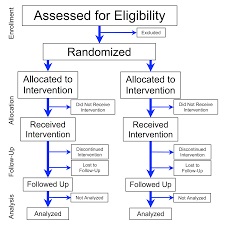
In the simplest kind of RCT, subjects are randomly assigned to 2 groups.  One group gets the treatment in which we are interested, & it is called the experimental group.   The other group gets either no treatment or standard treatment, & it is called the control group.  

Here’s an example from a study to determine whether chewing gum prevents postoperative ileus after laparotomy for benign gynecologic surgery:  A total of 109 patients were randomly assigned to receive chewing gum (n=51) or routine postoperative care (n=58).  Fewer participants assigned to receive chewing gum … experienced postoperative nausea (16 [31.4%] versus 29 [50.0%]; P=0.049) and postoperative ileus (0 vs. 5 [8.6%]; P=0.032).* There were no differences in the need for postoperative antiemetics, episodes of postoperative vomiting, readmissions, repeat surgeries, time to first hunger, time to toleration of clear liquids, time to regular diet, time to first flatus, or time to discharge. Conclusion?  Postop gum chewing is safe & lowers the incidence of nausea and ileus! (Jernigan, Chen, & Sewell, 2014. Retrieve from PubMed abstract)

Do you see the elements of an RCT in above?

Let’s break it down.

  • Randomized means that 109 subjects were randomly divided into 2 or more groups. In above case, 51 subjects ended up in a gum chewing group & 58 were assigned to a routine care, no gum group.  Randomization increases the chance that the groups will be similar in characteristics such as age, gender, etc.   This allows us to assume that different outcomes between groups are caused by gum-chewing, not by differences in group characteristics.
  • Controlled means that 1 of the groups is used as a control group. It is a comparison group, like the no-gum , standard care group above
  • Trial means that it was a study. The researchers were testing (trying) an intervention and measuring the outcomes to see if it worked.  In this case the intervention was gum chewing and the measure outcomes were nausea and ileus.

Why should you care about RCTs?  Because RCTs are strong evidence that an intervention works (or doesn’t) for your patients

Critical Thinking Exercise:   Go to http://www.ncbi.nlm.nih.gov/pubmed   In the blank box at the very top enter a few key words about the problem in which you are interested + RCT.  For example:  music pain + RCT.   Then read 1 or more of the abstracts looking for random assignment (randomized), control group, and whether it was a study (trial).   You’re on your way!    -Dr.H

*Note: You may remember from other blogs that p<.05 means the difference between groups is probably cause by the intervention—in this case gum chewing.