Category Archives: Observational research

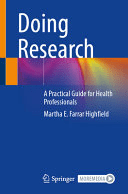
New book: “Doing Research: A Practical Guide”

Author: Martha “Marty” E. Farrar Highfield

NOW AVAILABLE ELECTRONICALLY & SOON IN PRINT.

CHECK OUT: https://link.springer.com/book/10.1007/978-3-031-79044-7

This book provides a step-by-step summary of how to do clinical research. It explains what research is and isn’t, where to begin and end, and the meaning of key terms. A project planning worksheet is included and can be used as readers work their way through the book in developing a research protocol. The purpose of this book is to empower curious clinicians who want data-based answers.

Doing Research is a concise, user-friendly guide to conducting research, rather than a comprehensive research text. The book contains 12 main chapters followed by the protocol worksheet. Chapter 1 offers a dozen tips to get started, Chapter 2 defines research, and Chapters 3-9 focus on planning. Chapters 10-12 then guide readers through challenges of conducting a study, getting answers from the data, and disseminating results. Useful key points, tips, and alerts are strewn throughout the book to advise and encourage readers.

Primer on Design: Part 3 – Mixing UP Methods

QUICK REVIEW: Research design is the overall plan for a study. And…there are 2 main types of design: 1) Non-experiments in which the researcher observes and documents what exists,

and 2) Experiments when the researcher tries out an intervention and measures outcomes.

NEW INFO: Two non-experimental research designs that are often confused with one another are: 1) cohort studies & 2) case studies. Epidemiologists often use these designs to study large populations.

In a cohort study, a group of participants, who were exposed to a presumed cause of disease or injury, are followed into the future (prospectively) to identify emerging health issues. Researchers may also look at their past (retrospectively) to determine the amount of exposure that is related to health outcomes.

In contrast, in a case controlled study, participants with a disease or condition (cases) and others without it (controls) are followed retrospectively to compare their exposure to a presumed cause.

EXAMPLES?

  1. Martinez-Calderon et al (2017 ) Influence of psychological factors on the prognosis of chronic shoulder pain: protocol for a prospective cohort study. BMJ Open, 7. doi: 10.1136/bmjopen-2016-012822
  2. Smith et al (2019). An outbreak of hepatitis A in Canada: The use of a control bank to conduct a case-control study. Epidemiology & Infection, 147. doi: https://doi.org/10.1017/S0950268819001870

CRITICAL THINKING: Do you work with a group that has an interesting past of exposure to some potential cause of disease or injury? Which of the above designs do you find more appealing and why?

reposting: dispelling the nice or naughty myth–retrospective observational study of santa claus

Check out this re-post of my Christmas-y blog:

Dispelling the nice or naughty myth: retrospective observational study of Santa Claus.