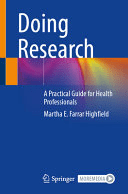
Author: Martha “Marty” E. Farrar Highfield
NOW AVAILABLE ELECTRONICALLY & SOON IN PRINT.
CHECK OUT: https://link.springer.com/book/10.1007/978-3-031-79044-7
This book provides a step-by-step summary of how to do clinical research. It explains what research is and isn’t, where to begin and end, and the meaning of key terms. A project planning worksheet is included and can be used as readers work their way through the book in developing a research protocol. The purpose of this book is to empower curious clinicians who want data-based answers.

Doing Research is a concise, user-friendly guide to conducting research, rather than a comprehensive research text. The book contains 12 main chapters followed by the protocol worksheet. Chapter 1 offers a dozen tips to get started, Chapter 2 defines research, and Chapters 3-9 focus on planning. Chapters 10-12 then guide readers through challenges of conducting a study, getting answers from the data, and disseminating results. Useful key points, tips, and alerts are strewn throughout the book to advise and encourage readers.

 Mixed methods (MM) research provides a more complete picture of reality by including both complementary quantitative and qualitative data.