Tag Archives: evidence based practice

Don’t Just Wish Upon Falling Stars: Take Evidence-based Action

The Joint Commission (TJC) published, Preventing falls and fall-related injuries in health care facilities, a new Sentinel Alert #55 on September 28, 2015 at http://www.jointcommission.org/assets/1/18/SEA_55.pdf

What’s the problem? Falls with serious injuries are among the top 10 events reported to TJC.   Analysis of that data shows that contributing factors are related to:

  • Inadequate assessment
  • Communication failures
  • Lack of adherence to protocols and safety practices
  • Inadequate staff orientation, supervision, staffing levels or skill mix
  • Deficiencies in the physical environment
  • Lack of leadership (page 1)

What to do?   Here are TJC recommendationsAction Plan

  1. Raise awareness of falls resulting in injury
  2. Establish an interprofessional falls committee
  3. Use a reliable, valid risk assessment tool
  4. Use EBP
    1. Standardized handoff including risk for falls
    2. One-to-one, bedside education of patients (& families?)
  5. Conduct post-fall management, which includes: a post-fall huddle; a system of honest, transparent reporting; trending and analysis of falls which can inform improvement efforts; and reassess the patient (page 2)

questionCritical thinking:  How would you apply AHRQ toolkit: Preventing Falls in Hospitals to your unit.

Want more info?   For tools, resources, & more details on above, see Joint Commission (2015, September 28). Preventing falls and fall-related injuries in health care facilities, Sentinel Event Alert, Issue 55.  Retrieved from Joint http://www.jointcommission.org/assets/1/18/SEA_55.pdf

“What was the question, again?” Hypothesis vs. Research question

imagesCAGYW6WBWhat is the difference between a hypothesis and a research question?  I suppose some will ask: “Why should I care?”  

The answer is that knowing the difference is a clue to how strong the research findings are.  Experimental studies that use hypothesis create stronger evidence for practice, than do non-experimental studies that merely answer research questions.

  • hypothesis is a predicted answer and focuses on cause-and-effect , such as “Those who take 80mg ASA every day will have lower incidence of MI’s than those who do not.”  When we know a lot about a topic already, then we can hypothesize (in other words make an educated guess about how the experiment will turn out).  A researcher may word the hypothesis in interrogative form with a question mark, but you can still recognize it as a hypothesis if it uses any terms like cause, effect, impact, increase, improve, or their synonyms and has at least 2 variables.
  • Researchers ask only a research question when they don’t know enough to guess about the cause and effect, & so they either 1) want merely to describe something or 2) to figure out whether 2 things are related to each other, but aren’t ready to identify one as causing the other. For example no one knows which came 1st, the chicken or the egg?—you can see that chickens and eggs are related 100% of the time, but you may win a Nobel prize if you can figure out which one originally caused the other.

Cause and effect (experimental, hypothesis) studies create stronger evidence for practice than do descriptive or correlational (non-experimental, question) studies.

Critical thinking question: One of the following is a hypothesis & one is a research question.  Which is wquestionhich and why?

  1.  The purpose of this study was to describe the expectations for pain relief of patients with abdominal pain and how their communication with providers relates to their overall pain relief. (Yee et al 2006)
  2.  We investigated whether a brief pain communication/education strategy would improve patient pain communication skills. (Smith et al, 2010)

“When Science Meets Sacred Cows”

Sometimes the scientific evidence is clear….but no one wants to change what they are doing.

Change is hard if providers, media, or members of the public are in love with keeping things the way they are, or have a vested interest in the status quo, or perhaps just don’t like change…or the evidence.  (Maybe we’re all a little guilty of this.)cow nosw

Check out this free, full-text editorial available through PubMed: http://www.o-wm.com/content/when-science-meets-sacred-cows  (Source: 2010 OWM).

Critical Thinking: What sacred cows should be put out to pasture in your or others’ practice?  What about using the Trendeleberg position to treat hypotension, checking foley balloons before insertion, other?  List a few areas where your organization HAS changed practice based on evidence.  What were the barriers & facilitators?

“I wonder as I wander…. ” DNP or PhD? What’s the diff?

Ever wonder what the difference is between the new Doctorate of Nursing Practice (DNP) and the Doctorate of Philosophy in nursing (PhD)?      examine baby

In short the focus of PhD education is to prepare the RN to create original research.  In contrast, DNP education is to prepare the RN to apply existing research to nursing practice.

Being a nurse practitioner (NP) is NOT the difference.  Also while some PhDs become skilled in applying research to practice & some DNPs do research,…their doctoral course preparation & final projects are quite different!

For more information:  Here’s a great comparison chart from one doctoral program:  https://nursingandhealth.asu.edu/degree-programs/doctoral-vs-phd-degrees-at-asu

Critical reflection: Based on your own personal career goals….questionIf you were to return for a doctorate, which would you find most useful?

METHODS in the Research Madness

[This is a re-post from 2014.  If you weren’t a reader then….read on…..]

fisheye booksResearch article sections are: Title, Abstract, Introduction/background,Methods, Results, Discussion, & Implications/Conclusions

METHODS =  Design, Sample, Setting, & Data collection instrument

Sometimes these above elements of METHODS are subheadings.

Sometimes not.

  • Key point #1: Design= overall plan for answering the question or proving the hypothesis.  KEYThe 2 basic types of design are 1) experimental & 2) non-experimental.   In experimental, the researcher does something to the subjects and measures the effects of that something.  In non-experimental, the research merely observes and describes what is happening without doing anything to change it.
  •  KEYKey point #2: Setting=where the study is conducted: home, hospital, office, classroom, on KEYan ocean cruise, or other.
  • Key point #3: Sample includes who/what subjects were in & excluded from the study; how many subjects were in the study; & whether subjects were selected using random methods or non-random methods.   In random selection every eligible subject has the same chance of being selected. That’s called probability sampling.  An example is drawing names from a hat.  In non-random selection only the most nearby subjects are asked to be in the study. That’s called non-probability or convenience sampling.  An example, using a clipboard to survey people who walk into a mall one day. [Note: Subjects can be people, animals, charts, hospitals, or nations.]

(Whew!….Enough for now.)

Critical Thinking Exercise:  Find the Design, Setting, & Sample in this excerpt of Methods from Mohammedkarimi et al, (2014): question

“A double-blind, randomized clinical trial (RCT) was performed among 90 adult patients with acute headache in Shahid Rahnemoon Emergency Center of Yazd city of Iran (45 patients in lidocaine group and 45 patients in placebo group). Patients with history of epilepsy, allergy to lidocaine, signs of skull base fracture, Glasgow Coma Scale (GCS) < 15, patients younger than 14 years and patients who had received any medication in previous 2 h were excluded.”

A 33,000 foot view: The Abstract

 Abstracts are great; abstracts are not enough!
An abstract will not give you enough information to accurately apply the study findings to practice.   An abstract typically summarizes all the other sections of the article, such as  the question the researcher wanted to answer, how the researcher collected data to answer it, and what that data showed.  This is great when you are trying to get the general picture, but you should Never assume that the abstract tells you what you need to know.
airplaneWingIsland
Abstracts can mislead you IF you do not read the rest of the article.  They are only a short 100-200 words and so the authors have to leave out key information.   You may misunderstand study results if you read only the abstract.   An abstract’s 33,000 foot level FootprintsInSand
description of a study, cannot reveal the same things that you can learn from an up-close look at details.  You want to know exactly who was in the study, exactly what the researcher did, & exactly how outcomes were measured!  You want to follow the researcher’s footprints up close, not just do a fly-over.
So…what is the takeaway?  Definitely read the abstract to get the general idea.  Then read the article beginning to end.  Don’t give up reading the full article just because some parts of the study may be hard to understand.  Just read and get what you can. Then try a re-read or get some help understanding any difficult sections.   This is an important step toward EBP.   [revised from my former blogsite]
Critical thinking:  What info is missing from this abstract at this link that you would want to know before using the findings of this pain study to practice?
http://www.ncbi.nlm.nih.gov/pubmed/25659796QUESTION

Finding the Needles in the Haystacks: Evidence Hunting Efficiently & Effectively

Searching for the right evidence is an art & a science.   In an effective search, the RN: twoOnComputer

  1. Identifies excellent key words based on a clear problem statement
  2. Systematically searches the best databases for those words
  3. Keeps a record of the search strategy.

This is actually a pretty simple time-saver because it keeps you from having to repeat searches because you can’t remember where you looked!!

Let’s take an example that we used previously.  Here’s how it was laid out in PICO (which stands for Population/problem, Intervention, Comparison intervention, & Outcome)

  • Population/problem= Postoperative patients with ileus (Patient population &Problem)
  • Intervention= Gum chewing postop (Intervention to try out)
  • Comparison intervention= NPO with gradual diet progression when bowel sounds start returning
  • Outcome= Reduce time of postop ileus with sooner return to nutritious eating

We would:magnifyingGlass

  1. Using PICO, identify key concepts (words), such as “postoperative ileus” “gum chewing” and “NPO.” Note that you can pick single words or combinations of words.
  2. Search for this set of words in the very comprehensive databases of PubMed and also in CINAHL. CINAHL is more nursing specific, and PubMed is one of the most comprehensive out there. Search from MOST RECENT to earlier.  Go for only most recent 5 years unless 5 years doesn’t give you enough articles.
  3. Keep notes of exactly which words and phrases you used to search each database

This 5 minute video shows you a GREAT way to make sure that your search is complete with minimal effort. It’s an easy-peasy tracking strategy for where you’ve already looked. https://www.youtube.com/watch?v=233DzkmimV4&list=PLE3A977BE32CF3956

CRITICAL THINKING: What are the key words of your clinical problem of interest.  (You can choose to use PICO or not.)  Plug them into PubMed.  Did you get enough articles?QUESTION

“The Sky is Falling!” (or Don’t be an EBP Chicken Little)

We all know the story of Chicken Little, right?  Chicken Little is walking through the forest, an acorn falls and hits her on the head, then Chicken Little  runs about in a panic telling everyone, “The sky is falling! The sky is falling!” A lot of the animals are convinced, and the fox—who knows the truth that it was only an acorn—convinces Chicken Little & some other animals to come into his den to be safe from the falling sky. There he eats them. Interestingly the fox used the correct evidence well. Chicken Little & fox chicken littlecompany used evidence poorly and created a safety hazard for themselves!
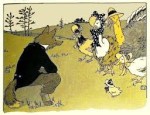
Moral of the story? Don’t be a Chicken Little when it comes to reading and applying research to practice. Get all the facts before you share the research findings with others. Don’t read only the “acorn” of abstract, introduction, and discussion, and then assume that you know what the research study shows and that you can apply it to your work. Don’t turn an acorn into a falling sky!

How to avoid being an EBP Chicken Little? To avoid being an Evidence-Based Practice (EBP) Chicken Little, you should follow the example of Samantha in this research fairy tale: “Samantha…read the study abstract. Then, while Chicken Little and her friends waited anxiously, she read the introduction, the literature review, the research questions, the methods section, the findings, and the discussion section. Then she went back and read all the sections again. Finally, as Chicken Little hopped around her impatiently, she reread the findings. “Chicken Little, have you and your friends read the entire study?” asked Samantha.” (source: https://www.son.rochester.edu/student-resources/research-fables/chicken-little.html)

Why go to all this trouble? I’m busy. The reasons to take time and effort to read the WHOLE study are many. First, the subjects may not be at all like your own patient population—what if the researchers studied only “left-pawed albino hamsters”? Second, the research might not be a strong meta-analysis or randomized controlled trial whose results can actually be applied to other times and places—what if the researchers just watched subjects walk around, but didn’t test what makes them walk better?  A third reason is that the results might be statistically significant, but clinically irrelevant!—what if researchers were studying pain, but everyone in the study had 1-2 on the pain scale?

You don’t want to endanger patient safety by misunderstanding and misapplying research and then be “eaten alive” by adverse patient outcomes or by critics, who will see through your mistakes. Remember in the fairy tale Chicken Little and his careless friends misunderstood the facts, and hence were susceptible to being eaten by a fox.

What if you don’t know how to read research? No problem. Everyone who knows how to read research now had to learn it—no one was born knowing.  So,…you can learn it, too!  It doesn’t take magical powers.  Countless resources are online; others are in your hospital or in a university research course. If you check the box on this page to follow the EBP blog, (I hope) it will help, too. Go back and read earlier blogs on sections of a research report.

For more information on how to be an EBP Chicken Little (NOT) see the very creative research fairy tale by Jeanne Grace (copyright Rochester College) at https://www.son.rochester.edu/student-resources/research-fables/chicken-little.html

Critical thinking:

  1. After reading Grace’s fairy tale at the above link list at least three (3) things that Chicken Little might have learned, had she read the whole article!
  2. Compare an abstract with a full article, and check out the differences. Specifically compare the abstract at  http://www.ncbi.nlm.nih.gov/pubmed/2606078 with what you learn about them from the full article at http://www.ncbi.nlm.http://www.ncbi.nlm.nih.gov/pubmed/2606078nih.gov/pmc/articles/PMC4449996/. Did reading the whole article change the way you understand how orQUESTION whether the study might apply to your work? If so, how? And if not, why not?

Ask King Charles II: “Why do we need evidence-based practice?”

Want to know the value of evidence in practice?  You might ask King Charles II (or at least his physicians who survived him).   Check out what happens when much of the evidence for practice was based on tradition & experts: https://www.youtube.com/watch?v=OeA_OKqqBJ4 (5:27).

Everyone agrees…..patients deserve the best care we can give now, even though we won’t know everything about anything until we know everything about everything (RCH personal communication)

Critical thinking:  What is one practice that you learned in nursing school, that has already changed?   Why did it change?QUESTION

For some evidence that you can probably put to use right away to give patient-centered, family-centered care, check out this user friendly summary from UCSD! https://www.youtube.com/watch?v=Q_hs-uNBdPQ (4:48)

“Is it?” “It is!” Expert opinion as valuable evidence for practice.

Remember back when you asked your mom why you should make your bed, set the table, or do some other then-distasteful task? Maybe you said, “Do I have to?”

Because I Said SoRemember her answer? Sometimes it was just: “Because I said so!” Was that enough evidence to support your practice of setting the table or making your bed?  You bet! After all she was THE expert on such things.

Likewise…is expert opinion good evidence for your practice? Yes, it is. EXPERT OPINION of individuals or committees is the 7th level of evidence for nursing practice (Melnyk & Fineout-Overholt, 2005), and should be considered.

Of course the first question that you must ask is: “Is the person/committee (who is telling you how to prevent falls, promote safety, teach patients, and so on and on) an actual EXPERT on that topic?” The answer is a matter of judgment. If the person/committee has special education, credentials, or experience or is a recognized authority on the topic about which they are giving advice, then you could reasonably conclude yes, they are experts. In that case the advice should be considered evidence for practice.    (Caution: Your judgment of their expertise matters!–don’t just follow along.  Don’t forget that person who is expert in one area may not be an expert in another.)

The 2nd question that you must ask is; “Does any research or stronger level of evidence exist on the topic?”

  • If it does NOT exist, then you should use that expert opinion in combination with scientific principles, anecdotal case reports, and theory. Or you might create some new research yourself. (Source=Iowa EBP Model)
  • If it DOES EXIST, then you should pay most attention to the stronger evidence and interpret the weaker evidence of expert opinion in that light.

QUESTIONCritical thinking:  Try your new knowledge in this example. Many educators and professionals who run journal clubs consider journal clubs effective based on feedback from participants. At least in 2008, 80% of experimental studies suggested that journal clubs helped with learning and being able to critically review a research article. However, no research is available on whether the learning from journal clubs actually translates into practice (Deenadayalan et al., 2008). You are considering a journal club. What would you decide to do and why?

For more, see: