Category Archives: Narrative research

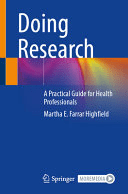
New book: “Doing Research: A Practical Guide”

Author: Martha “Marty” E. Farrar Highfield

NOW AVAILABLE ELECTRONICALLY & SOON IN PRINT.

CHECK OUT: https://link.springer.com/book/10.1007/978-3-031-79044-7

This book provides a step-by-step summary of how to do clinical research. It explains what research is and isn’t, where to begin and end, and the meaning of key terms. A project planning worksheet is included and can be used as readers work their way through the book in developing a research protocol. The purpose of this book is to empower curious clinicians who want data-based answers.

Doing Research is a concise, user-friendly guide to conducting research, rather than a comprehensive research text. The book contains 12 main chapters followed by the protocol worksheet. Chapter 1 offers a dozen tips to get started, Chapter 2 defines research, and Chapters 3-9 focus on planning. Chapters 10-12 then guide readers through challenges of conducting a study, getting answers from the data, and disseminating results. Useful key points, tips, and alerts are strewn throughout the book to advise and encourage readers.

Historical research: Free zoom, 10/24, 12N (ET).

UVA Bjoring Center for Nursing History Forum”Narrating a Life of Care: Hindsight, Omission, and Ambiguities of Interpretation in the History of Religion and Health”

Angela Xia October 24, 2023

 12 p.m. (ET) on Zoom

Hosted by the UVA Bjoring Center for Nursing Historical InquiryZoom link: : https://virginia.zoom.us/j/93585126052?pwd=YzBxZ0V3ZGd2ZElvSGpTWWUxZ0V5Zz09 Meeting ID: 935 8512 6052
Passcode: 590924
Doctoral candidate Angela Xia will share findings from her dissertation research on religion, aging, and end of life care in the modern U.S., focusing on the lives of three women of color in the fields of elder and palliative health. In addition to their professional roles as health-care practitioners, what makes these three women — nurse Dr. Rita Kathleen Chow, palliative social worker Dr. Bernice Catherine Harper, and hospice oncologist Dr. Josefina Bautista Magno — distinct are the self-proclaimed connections between their religious identities and their philosophies of care, connections established in self-narrated sources such as memoir, autobiography, interviews, or reminiscences from colleagues and friends. What can such sources tell historians of religion and medicine about the relationship between a care practitioner’s religious subjectivity and their work? What effects do phenomena such as hindsight, omission, recalcitrance, devotion, or revision have on how such relationships are depicted? With such questions in hand, Angela’s talk will explore what it means to narrate a life of care with care.

Angela Xia is a scholar of religion and health in the modern U.S. and a Ph.D. candidate in the Department of Religious Studies at the University of Pennsylvania. Her dissertation, “The Rest of Life: Care and Aging in American Churches, 1970-2000,” offers the first historical account of how American religious leaders, educators, and care providers took up age as a matter of shared concern in the latter half of the 20th century. Her research has been supported by the Barbara Bates Center for the Study of the History of Nursing, the Bjoring Center for Nursing Historical Inquiry, and the Consortium for the History of Science, Technology, and Medicine. 

We hope you can join us! Maura Singleton
Center Manager
Eleanor Crowder Bjoring Center for Nursing Historical Inquiry

mks2d@virginia.edu
P 434.924.0083; 434.989.1550 (cell)

UVA School of Nursing
202 Jeanette Lancaster Way
P.O. Box 800782
Charlottesville, VA 22908-0782

www.nursing.virginia.edu/nursing-history/

Listen up! Don’t interrupt!

Researchers collect two types of data in their studiescounting-sheetword-art

  1. Numbers (called quantitative data)
  2. Words & narratives (called qualitative data)

StorytellerOne source of rich word or narrative (qualitative) data for answering nursing questions is nurses’ stories.  Dr. Pat Benner RN, author of Novice to Expert explains two things we can do to help nurses fully tell their stories so we can learn the most from their practice.

  1. Listen well without interrupting
  2. Help nurses ‘unpack’ their stories 

Check out this excellent 2:59 video of Dr. Benner’s and revolutionize how you learn about nursing from nursing stories:  Preview: The use of Narratives 

Critical thinking:  For a study using narratives in research see  Leboul et al. (2017).  Palliative sedation challenging the professional competency of health care providers and staff: A qualitative focus group and personal written narrative study.  [full text available thru PubMed at https://www.ncbi.nlm.nih.gov/pubmed/28399846].    1) Do you think the authors listened and unpacked information from the focus groups & written narratives; 2)  Do you think there might be a difference in the way people write narratives and verbally tell narratives?   3) How might that difference if any affect the research findings?

For more information:  Check out The Power of Story  by Wang & Geale (2015) at http://www.sciencedirect.com/science/article/pii/S2352013215000496