Actually when it comes to quantitative data, there are 4 levels, but who’s counting? (Besides Goldilocks.)
- Nominal (categorical) data are names or categories: (gender, religious affiliation, days of the week, yes or no, and so on)
- Ordinal data are like the pain scale. Each number is higher (or lower) than the next but the distances between numbers are not equal. In others words 4 is not necessarily twice as much as 2; and 5 is not half of 10.
- Interval data are like degrees on a thermometer. Equal distance between them, but no actual “0”. 0 degrees is just really, really cold.
- Ratio data are those with real 0 and equal intervals (e.g., weight, annual salary, mg.)
(Of course if you want to collect QUALitative word data, that’s closest to categorical/nominal, but you don’t count ANYTHING. More on that another time.)
CRITICAL THINKING: Where are the levels in Goldilocks and the 3 levels of data at this link: https://son.rochester.edu/research/research-fables/goldilocks.html ?? Would you measure soup, bed, chairs, bears, or other things differently? Why was the baby bear screaming in fright?

 meaning of results) is
 research evidence) in practice. While researchers create new knowledge,


 answers to a research question: “Why is the sky blue?”
 Go to full article
 during Christmas 2015. This was correlated with rates of absenteeism from primary school, conviction rates in young people (aged 10-17 years), distance from hospital to North Pole (closest city or town to the hospital in kilometres, as the reindeer flies), and contextual socioeconomic deprivation (index of multiple deprivation).
 Is it quantitative or qualitative research? Experimental or non-experimental research? How generalizable is this research? What are the risks,resources, and readiness of people in potentially using the findings (Stetler & Marram, 1996; Stetler, 2001)? What might happen if you try to apply the abstract information to practice without reading the full article? Do you think the project done in Europe is readily applicable to America? What would be the next level of research that you might undertake to better confirm these findings?



 case study, systematic review, or clinical practice guideline? Check out these standardized reporting guidelines:
 2017)
2017) 
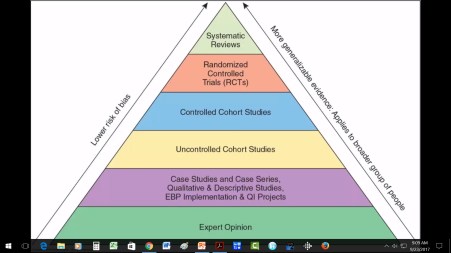
 research. My key point? Much so-called “unfiltered research” has been screened (filtered) carefully through peer-review before publication; while some “filtered research” may have been ‘filtered’ only by a single expert & be out of date. If we use the terms filtered and unfiltered we should not be naive about their meanings. (Pyramid source:
  You may have heard of Benner’s Novice to Expert theory. Benner used in-depth, qualitative interview descriptions as data to generate her theory. Yet that type of research evidence is missing from medicine’s pyramid! Without a clear foundation the pyramid will just topple over. Better be clear!