This book provides a step-by-step summary of how to do clinical research. It explains what research is and isn’t, where to begin and end, and the meaning of key terms. A project planning worksheet is included and can be used as readers work their way through the book in developing a research protocol. The purpose of this book is to empower curious clinicians who want data-based answers.
Doing Research is a concise, user-friendly guide to conducting research, rather than a comprehensive research text. The book contains 12 main chapters followed by the protocol worksheet. Chapter 1 offers a dozen tips to get started, Chapter 2 defines research, and Chapters 3-9 focus on planning. Chapters 10-12 then guide readers through challenges of conducting a study, getting answers from the data, and disseminating results. Useful key points, tips, and alerts are strewn throughout the book to advise and encourage readers.
QUICK REVIEW: Research design is the overall plan for a study. And…there are 2 main types of design: 1) Non-experiments in which the researcher observes and documents what exists,
and 2) Experimentswhen the researcher tries out an intervention and measures outcomes.
NEW INFO: Two non-experimental research designs that are often confused with one another are: 1) cohort studies & 2) case studies. Epidemiologists often use these designs to study large populations.
In a cohort study, a group of participants, who were exposed to a presumed cause of disease or injury, are followed into the future (prospectively) to identify emerging health issues. Researchers may also look at their past (retrospectively) to determine the amount of exposure that is related to health outcomes.
In contrast, in a case controlled study, participants with a disease or condition (cases) and others without it (controls) are followed retrospectively to compare their exposure to a presumed cause.
CRITICAL THINKING: Do you work with a group that has an interesting past of exposure to some potential cause of disease or injury? Which of the above designs do you find more appealing and why?
Mixed methods (MM) research provides a more complete picture of reality by including both complementary quantitative and qualitative data.
A clinical analogy for MM research is asking patients to rate their pain numerically on a 0–10 scale and then to describe the pain character in words.
MM researchers sometimes include both experimental hypotheses and non-experimental research questions in the same study.
Common MM subtypes are in the below table. In concurrent designs investigators collect all data at the same time, and in sequential designs they collect one type of data before the other. In triangulated MM, data receive equal weight, but in embedded designs, such as a large RCT in which only a small subset of RCT participants are interviewed, the main study data is weighted more heavily. In sequential MM, researchers give more weight to whatever type of data were collected first; for exploratory this is qualitative data and for explanatory it is quantitative data.
A research design is the investigator-chosen, overarching study framework that facilitates getting the most accurate answer to a hypothesis or question. Think of research design as similar to the framing of a house during construction. Just as house-framing provides structure and limits to walls, floors, and ceilings, so does a research design provide structure and limits to a host of protocol details.
Tip. The two major categories of research design are: 1) Non-experimental, observation only and 2) Experimental testing of an intervention.
DESCRIPTIVE STUDIES
Non-experimental studies that examine one variable at a time.
When little is known and no theory exists on a topic, descriptive research begins to build theory by identifying and defining key, related concepts (variables). Although a descriptive study may explore several variables, only one of those is measured at a time; there is no examination of relationships between variables. Descriptive studies create a picture of what exists by analyzing quantitative or qualitative
data to answer questions like, “What is [variable x]?” or “How often does it occur?” Examples of such one-variable questions are “What are the experiences of first-time fathers?” or “How many falls occur in the emergency room?” (Variables are in italics.) The former question produces qualitative data, and the latter, quantitative.
Descriptive results raise important questions for further study, and findings are rarely generalizable. You can see this especially in a descriptive case study: an in-depth exploration of a single event or phenomena that is limited to a particular time and place. Given case study limitations, opinions differ on whether they even qualify as research.
Descriptive research that arises from constructivist or advocacy assumptions merits particular attention. In these designs, researchers collect in-depth qualitative information about only one variable and then critically reflect on that data in order to uncover emerging themes or theories. Often broad data are collected in a natural setting in which researchers exercise little control over other variables. Sample size is not pre-determined, data collection and analysis are concurrent, and the researcher collects and analyzes data until no new ideas emerge (data saturation). The most basic qualitative descriptive method is perhaps content analysis, sometimes called narrative descriptive analysis, in which researchers uncover themes within informant descriptions. Figure 4 identifies major qualitative traditions beyond content analysis and case studies.
Alert! All qualitative studies are descriptive, but not all descriptive studies are qualitative.
Box 1. Descriptive Qualitative Designs
Design
Focus
Discipline of Origin
Ethnography
Uncovers phenomena within a given culture, such as meanings, communications, and mores.
Anthropology
Grounded Theory
Identifies a basic social problem and the process that participants use to confront it.
Sociology
Phenomenology
Documents the “lived experience” of informants going through a particular event or situation.
Psychology
Community participatory action
Seeks positive social change and empowerment of an oppressed community by engaging them in every step of the research process.
Marxist political theory
Feminist
Seeks positive social change and empowerment of women as an oppressed group.
Research is using the scientific process to ask and answer questions by examining new or existing data for patterns. The data are measurements of variables of interest. The simplest definition of a variable is that it is something that varies, such as height, income, or country of origin. For example, a researcher might be interested in collecting data on triceps skin fold thickness to assess the nutritional status of preschool children. Skin fold thickness will vary.
Research is often categorized in different ways in terms of: data, design, broad aims, and logic.
Qualitative Data
Data. Studies that use numerical data to measure variables are called quantitative research. The Results section will be full of numbers! In contrast, other studies use word data to describe the nature of something, and these are called qualitative research (e.g., what words and ideas did person use to describe their experiences as part of a grief group). Qualitative results include themes. Research that uses both types of data in the same study is called mixed methods research (e.g., Meaning Making After the Loss of One’s Child).
Design. Study design is the overall plan for conducting a research study, and there are three basic designs: descriptive, correlational, and experimental.
Descriptiveresearch attempts to answer the question, “What exists?” It tells us what the situation is, but it cannot explain why things are the way they are. e.g., How much money do nurses make?
Correlational research answers the question: “What is the relationship” between variables (e.g., age and attitudes toward work). It cannot explain why those variables are or are not related. e.g.,relationship between nurse caring and patient satisfaction
Experimental research tries to answer “Why” question by examining cause and effect connections. e.g., gum chewing after surgery speeds return of bowel function. Gum chewing is a potential cause or “the why”
Aims. Studies, too, may be either applied research or basic research. Applied research is when the overall purpose of the research is to uncover knowledge that may be immediately used in practice (e.g., whether a scheduled postpartum quiet time facilitates breastfeeding). In contrast, basic research is when the new knowledge has no immediate application (e.g., identifying receptors on a cell wall).
Logic. Study logic may be inductive or deductive. Inductive reasoning is used in qualitative research; it starts with specific bits of information and moves toward generalizations [e.g., This patient’s pain is reduced after listening to music (specific); that means that music listening reduces all patients pain (general)]. Deductive reasoning is typical of quantitative research; it starts with generalizations and moves toward specifics [e.g., If listening to music relaxes people (general), then it may reduce post-operative pain (specific)]. Of course the logical conclusions in each case should be tested with research!
WHAT RESEARCH IS NOT:
Research as a scientific process is not going to the library or searching online to find information. It is also different from processes of applying research and non-research evidence to practice (called Evidence-Based Practice or EBP). And it is not the same as Quality Improvement (QI). See Two Roads Diverged for a flowchart to help differentiate research, QI and EBP.
“Measure twice. Cut once!” goes the old carpenter adage. Why? Because measuring accurately means you’ll get the outcomes you want!
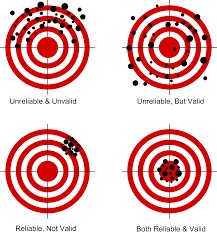
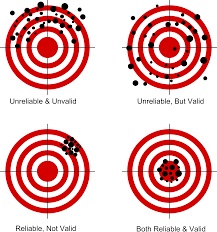
Same in research. A consistent and accurate measurement will get you the outcomes you want to know. Whether an instrument measures something consistently is called reliability. Whether it measures accurately is called validity. So, before you use a tool, check for its reported reliability and validity.
Psychological researchers do not simply assume that their measures work. Instead, they conduct research to show that they work. If they cannot show that they work, they stop using them.
There are two distinct criteria by which researchers evaluate their measures: reliability and validity. Reliability is consistency across time (test-retest reliability), across items (internal consistency), and across researchers (interrater reliability). Validity is the extent to which the scores actually represent the variable they are intended to.
Validity is a judgment based on various types of evidence. The relevant evidence includes the measure’s reliability, whether it covers the construct of interest, and whether the scores it produces are correlated with other variables they are expected to be correlated with and not correlated with variables that are conceptually distinct.
The reliability and validity of a measure is not established by any single study but by the pattern of results across multiple studies. The assessment of reliability and validity is an ongoing process.
A pilot study is to research what a trial balloon is to politics.
In politics, a trial balloon is communicating a law or policy idea via media to see how the intended audience reacts to it. A trial balloon does notanswer the question, “Would this policy (or law) work?” Instead a trial balloon answers questions like “Which people hate the idea of the policy/law–even if it would work?” or “What problems might enacting it create?” In other words, a trial balloon answers questions that a politician wants to know BEFORE implementing a policy so that the policy or law can be tweaked to be successfully put in place.
In research, a pilot study is sort of like a trial balloon. It is “a small-scale test of the methods and procedures” of a planned full-scale study (Porta, Dictionary of Epidemiology, 5th edition, 2008). A pilot study answers questions that we want to know BEFORE doing a larger study, so that we can tweak the study plan and have a successful full-scale research project. A pilot study does NOT answer research questions or hypotheses,such as “Does this intervention work?” Insteada pilot study answers the question “Are these research procedures workable?”
A pilot study asks & answers: “Can I recruit my target population? Can the treatments be delivered per protocol? Are study conditions acceptable to participants?” and so on. A pilot study should have specific measurable benchmarks for feasibility testing. For example if the pilot is finding out whether subjects will adhere to the study, then adherence might be defined as “70 percent of participants in each [group] will attend at least 8 of 12 scheduled group sessions.” Sample size is based on practical criteria such as budget, participant flow, and the number needed to answer feasibility questions (ie. questions about whether the study is workable).
A pilot study does NOT: Test hypotheses (even preliminarily); Use inferential statistics; Assess safety of a treatment; Estimate effect size; Demonstrate safety of an intervention.
Let’s say you want to find out how well students’ think they learned theory in your class.
One option is to do a pre/post test: You distribute the same survey before and after the class asking them to rate on 1-4 scale how well they think they know the new material. Then you compare their ratings.
Another option is to do posttest only: You could give them a survey after the class that asks them to rate 1-4 their knowledge before the class and 1-4 their knowledge now. Then you compare their ratings.
One research option is stronger than the other. Which one is it? and Why? (hint: think retrospective/prospective)
Reliability & validity are terms that refer to the consistency and accuracy of a quantitative measurement questionnaire, technical device, ruler, or any other measuring device. It means that the outcome measure can be trusted and is relatively error free.
Reliability– This means that the instrument measures CONSISTENTLY
Validity – This means that the instrument measures ACCURATELY. In other words it measures what it is supposed to measure and not something else.
For example: If your bathroom scale measures weight, then it is a valid measure of weight (e.g. it doesn’t measure BP or stress). You might say it had high validity. If your bathroom scale measures your weight as the same thing when you step on and off of it several times then it is measuring weight reliably or consistently; and you might say it has high reliability.



 Mixed methods (MM) research provides a more complete picture of reality by including both complementary quantitative and qualitative data.












 asks them to rate 1-4 their knowledge before the class and 1-4 their knowledge now. Then you compare their ratings.
