This book provides a step-by-step summary of how to do clinical research. It explains what research is and isn’t, where to begin and end, and the meaning of key terms. A project planning worksheet is included and can be used as readers work their way through the book in developing a research protocol. The purpose of this book is to empower curious clinicians who want data-based answers.
Doing Research is a concise, user-friendly guide to conducting research, rather than a comprehensive research text. The book contains 12 main chapters followed by the protocol worksheet. Chapter 1 offers a dozen tips to get started, Chapter 2 defines research, and Chapters 3-9 focus on planning. Chapters 10-12 then guide readers through challenges of conducting a study, getting answers from the data, and disseminating results. Useful key points, tips, and alerts are strewn throughout the book to advise and encourage readers.
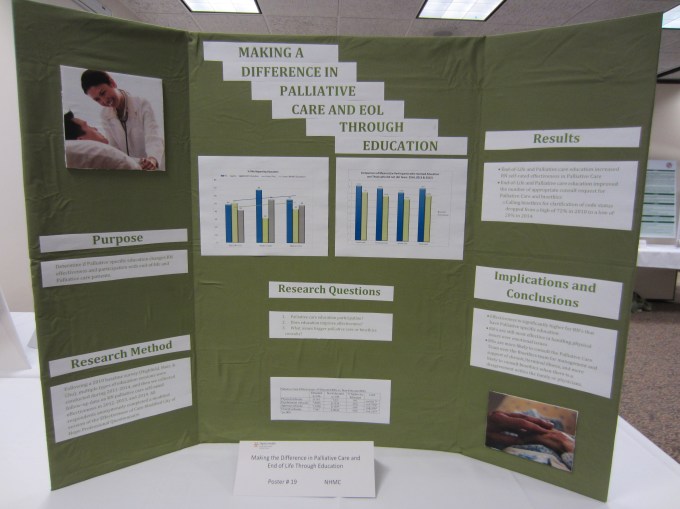
Congratulations—You and your team have completed a project!
Now what? Disseminate your work of course so that others can learn. A poster is a great way to do this. Dissemination is a key step in research & evidence-based practice.
But how should you present the information on your poster?To quote a well-known
politician: “What difference does it make” how you present your project in a poster. Quite a bit, it turns out! Some posters are definitely better than others.
For your poster you want to realize that you are dealing with a VISUAL medium, not text. This means that you need:
A CLEAR FOCUSon the key ideas & results
CONTENT THAT FLOWS. You want to make sure the reader is guided through the poster–maybe by numbering steps or adding arrows.
Enough “WHITE SPACE” that the readers eye has time to “rest” and that draws attention to your focus. (e.g., think “Got Milk?” in bold white letters on a black background. White space =any color blank space.)
USE VISUAL– Employ short phrases, bullet points, active voice, and graphics that take advantage of the visual medium. Some people say 50% should be graphics.
OK
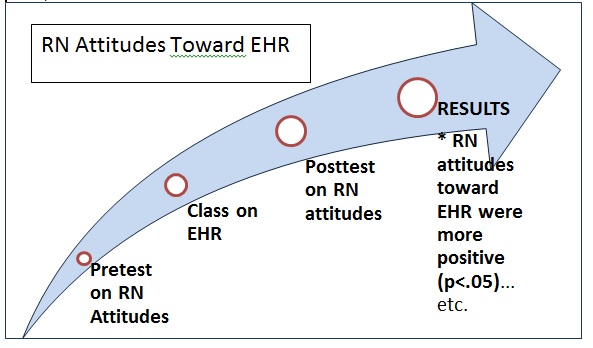
For example, let’s look at 3 different ways that you could present your pretend research study on RN attitudes to electronic health records (EHR). The NOVICE POSTER-MAKER may put the following on their poster:
“RN attitudes toward the new electronic health record were examined in a pretest, and class was taught on how to use the electronic health record. After the class a posttest of their attitudes was conducted.”
The above example has several problems! It is in passive voice. It has too many extra words. It is plain text and not the visual. It doesn’t give results. Is someone going to stand there and read your poster like an article? Nope. You need to make it different!
To make a difference, TRY THIS SOLUTIONto present the same information as bullet point phrases:
Better?
Key variable: RN attitudes toward electronic health record (EHR)
Pretest of RN attitudes to EHR
Class on improved use
Posttest of RN attitudes toward EHR showed improvement (p<.05)
Best?
OR PERHAPS TO MAKE AN EVEN BETTER DIFFERENCE—KEEP IT REALLY VISUAL, WITH FLOW AND FOCUS (using graphics when possible instead of words)


 present your project in a poster. Quite a bit, it turns out! Some posters are definitely better than others.
 Critique this poster or another using the “60 second poster evaluation” at