
Last post I commented on the potentially misleading terms of Filtered & Unfiltered  research. My key point? Much so-called “unfiltered research” has been screened (filtered) carefully through peer-review before publication; while some “filtered research” may have been ‘filtered’ only by a single expert & be out of date. If we use the terms filtered and unfiltered we should not be naive about their meanings. (Pyramid source: Wikimedia Commons )
This week, I address what I see as a 2nd problem with this evidence based medicine pyramid. That is, missing in action from it are descriptive, correlation, & in-depth qualitative research are not mentioned. Where are they? This undercuts the EBM pyramid as a teaching tool and also (intentionally or not) denigrates the necessary basic type of research on which stronger levels of evidence are built. That foundation of the pyramid, called loosely “background information,” includes such basic, essential research.
 You may have heard of Benner’s Novice to Expert theory. Benner used in-depth, qualitative interview descriptions as data to generate her theory. Yet that type of research evidence is missing from medicine’s pyramid! Without a clear foundation the pyramid will just topple over. Better be clear!
I recommend substituting (or at least adding to your repertoire) an Evidence Based NURSING (EBN) pyramid. Several versions exist & one is below that includes some of the previously missing research! This one includes EBP & QI projects, too! Notice the explicit addition of detail to the below pyramid as described at https://www.youtube.com/watch?v=MfRbuzzKjcM.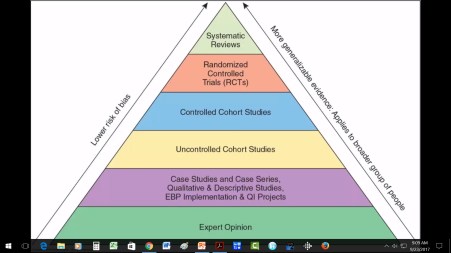
Critical thinking: #1List some EBM & EBN pyramid differences. #2 Figure out where on the hierarchy this project would go: Crowell, J., OʼNeil, K., & Drager, L. (2017). Project HANDS: A bundled approach to increase short peripheral catheter dwell time. Journal of Infusion Nursing, 40(5), 274-280. doi: 10.1097/NAN.0000000000000237. 1st use medicine’s EBM pyramid; & then 2nd use nursing’s EBN pyramid. #3 Label Crowell et al.’s study as filtered or unfiltered and explain what you mean by that.
For more info: Watch the YouTube video at the link above.


 Abstracts can mislead
  encourage us, Don’t give up reading the full article just because some parts of the study may be hard to understand. Just read and get what you can, then re-read the difficult-to-understand parts. Get some help with those PRN.
 “Once you see Nightingale’s graph, the terrible picture is clear. The Russians were a minor enemy. The real enemies were cholera, typhus, and dysentery. Once the military looked at that eloquent graph, the modern army hospital system was inevitable. You and I are shown graphs every day. Some are honest; many are misleading….So you and I could use a Florence Nightingale today, as we drown in more undifferentiated data than anyone could’ve imagined during the Crimean War.” (Source: Leinhard, 1998-2002)
 will know the technical things you need to plan into your study in order to make the study ‘sparkle’ and to get approval from human subjects review committees. The person doesn’t have to be an expert on your topic. You fill that role, or soon will!
 librarians are worth their weight in gold! Librarians can help you find what others have learned about your topic already, and then you can build on that knowledge. [note: check out
  This will help you to establish whether or not there really is a problem to be solved. Descriptive studies are much simpler to conduct and analyze than experimental studies in which you measure something, make an improvement, and then see if the improvement improved things. For example, you would measure sleep interruptions, institute a quiet time, and then measure sleep interruptions again to see if there were fewer. [check out
  Every researcher from time to time can feel ‘bogged down’ or bored with what they are doing, & one of the best protections against that is making sure you think the topic is super-interesting in the first place. If you get a little bored or stuck later don’t be surprised; it just means you’re pretty normal. Those stuck times might even feel like “hitting the wall” in a long race, and once you get past it things get better. Remind yourself why you loved the topic in the first place. Talk to your PhD friend or a mentor for encouragement. Take a little break. Read something really interesting about your topic.



 Is pain experience as diverse as our populations? This week I came across an interesting meta-analysis.
 (RCTs) or experimental studies is the strongest type of MA. MA based on descriptive or non-experimental studies is a little less strong, because it just describes things as they seem to be; & it cannot show that one thing causes another.
 your practice? Or should it? How can you use the findings with your patients? Should each patient be treated as a completely unique individual? Or what are the pros & cons of using this MA to give us a starting point with groups of patients? [To dialogue about this, comment below.]
 library using reference above. It is available electronically pre-publication. Also check out my


