Category Archives: Writing

Be Kind to Editors and Writers Month

I love this!! To all you readers, writers, editors, and wanna-be readers, wanna-be writers, and wanna-be editors: Happy September 2025!

Here’s a good-reading gift for you all about kindness: Editor & wordsmith Lillie Ammann’s blog.

If you have published letters to the editor, articles, abstracts, posters, or books, let us know in the comments. If you have authored one of these, make sure you put it up on Digital Commons for global access or ResearchGate. And check out others’ work there.

Happy writing & editing! -Dr.H/Marty

Zotero!!

No. Zotero is not a shout like “Cowabunga!” Nor is Zotero the little brother of Zoro, the masked cowboy hero.

ZoteroBib is a free, online tool that quickly formats references into the right style–whether that style be APA, Chicago, or 10,000+ other available formats. Once it generates the formatted reference you can manually correct any mistakes.

To use ZoteroBib go to zbib.org, enter reference info, and select your desired format. You can create an entire bibliography, and then create an editable rtf copy and paste that bibliography into your own paper. ZoteroBib also facilitates insertion of footnotes in the text, including specific reference page #’s for quotes.

You need enter only your reference’s doi or URL or PMID to generate the whole, properly formatted reference. Or you can enter more article/source information.

Here’s a sparkling water toast to well-formatted and well-footnoted papers!

[Special thanks to Librarian Marcia Henry at CSU/Northridge who made me aware of this tool.]

Five(5) great AI tools for research: Using without hallucinating

AI is getting better at 1) organizing information & 2) making suggestions for planning and writing research.

1st—a word of warning: Always verify AI-generated content USING YOUR OWN KNOWLEDGE!! Otherwise you’ll likely have AI hallucinations–content that is wrong, deceptive, or just plain nonsense. Scary!

Marek Kiczkowiak (speaker in below video) gives the AI-research-assistant gold medal to SCISPACE . AI SCISPACE bills itself as “The Fastest Research Platform Ever: All-in-one AI tools for students and researchers.” It performs a host of tasks, including creating slides from your paper. Other AI tools, like jenni or ResearchRabbit do some things better or differently. Watch this informative video, & try the tools.

What ethics questions does this raise? Two are: 1) questions of plagiarism (stealing) and 2) questions of how much YOU are learning when being AI-assisted.

Publishers are beginning to ask authors to what extent (if any) AI was used in a submitted paper. Moreoever, caution about plagiarizing is a cheap price for a clean conscience & learning what you need to learn. Hang onto those outcomes. “Above all else, guard your heart, for everything you do flows from it” -Proverb 4:23.

Here’s a second video for some help on avoiding plagiarism.

Your thots?

———————————————————–

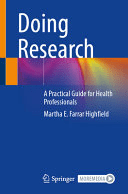
Also, check out my 2025 book Doing Research (~100pp) that is written to help make the difficult simple.

[Best place to purchase now is this link: Springer. Amazon is stocking it erratically for reasons mysterious to the publisher.]

New book: “Doing Research: A Practical Guide”

Author: Martha “Marty” E. Farrar Highfield

NOW AVAILABLE ELECTRONICALLY & SOON IN PRINT.

CHECK OUT: https://link.springer.com/book/10.1007/978-3-031-79044-7

This book provides a step-by-step summary of how to do clinical research. It explains what research is and isn’t, where to begin and end, and the meaning of key terms. A project planning worksheet is included and can be used as readers work their way through the book in developing a research protocol. The purpose of this book is to empower curious clinicians who want data-based answers.

Doing Research is a concise, user-friendly guide to conducting research, rather than a comprehensive research text. The book contains 12 main chapters followed by the protocol worksheet. Chapter 1 offers a dozen tips to get started, Chapter 2 defines research, and Chapters 3-9 focus on planning. Chapters 10-12 then guide readers through challenges of conducting a study, getting answers from the data, and disseminating results. Useful key points, tips, and alerts are strewn throughout the book to advise and encourage readers.

Free, virtual seminar: How to publish in peer review journal

This Wiley sponsored online seminar should provide good information on how to disseminate your project findings!

Click here: How to publish in a peer reviewed journal

Writing up Research!

A new article on the Nurse Author & Editor website :

Reporting Nursing Research, An Essay on Style: Beginnings

I highly recommend the Nurse Author & Editor website if you are writing anything from an abstract for a conference to a book from your thesis or dissertation. Keep disseminating your good work!

Your public persona: Name matters

This applies to you current and future authors. (Don’t think you won’t be one someday!)

Try to find an author name you can stick with. You want people to easily find all your work. What to consider? What does the future hold? Here’s some help from new online article in Nurse Author & Editor:

Is “data” singular or plural?

I’m a stickler for the plural.  (Peer reviewers are, too.) What’s your take?

Easy to read. Hard to write.

Musings:  For me the most difficult to write sections of a research report are the Intro/Background and Discussion.  And yet,  those are apparently the easiest to read for many.   My students at least tend to read only those sections and skip the rest.

Why? For the author, Intro/Background and Discussion require hard, critical thinking about what is already known about the topic (Intro/Background) and then what one’s findings mean in light of that (Discussion).  For research consumers, the language used in these sections is more familiar, ordinary sounding words.  On the other hand, writing the technical nature of other sections (Methods, Instruments, Results) is pretty straightforward with scientifically standardized vocabulary and structure.  But, for readers, those same sections contain potentially unfamiliar research terminology that is not part of everyday conversation– i.e., scientific vocabulary.  Quantitative studies often create more reader difficulty.

My solution for myself as a writer? To spend time making sure that the first sentence of every paragraph in Intro/Background and Discussion makes a step-by-step argument supported by the rest of the paragraph. Follow standardized structure for the rest.  Keep  language  precise  yet  simple  as  possible.

Solution for research readers? Read the whole article understanding what you can and keep a research glossary handy (e.g., https://sites.google.com/site/nursingresearchaid/week-1. Even if practice doesn’t make you perfect, it works in learning a new language–whether it is  a ‘foreign’ language or a scientific one.

Critical Thinking:  Test out your reading skills with this article https://www.ncbi.nlm.nih.gov/pmc/articles/PMC6503597/   .  Do the authors make systematic arguments in Intro/Background & Discussion? What makes this article hard or easy to read?

Happy Summer! -Dr.H

“It’s a jungle out there:” Predatory Journals

Cool. You completed your project and now want to publish it.

Beware! Predatory journals are ready to snap up your work!  It helps them, but not you.

What is a predatory journal?  One that can eat you and your paper alive.

  • tiger junglePredatory journals don’t meet quality peer-review standards.
  • The predator may post your manuscript online, which then vanishes from access.
  • If you are writing an article and cite a predator-published manuscript, you undercut your own credibility.
  • If you’re counting on the article for credit towards tenure, your personnel reviewers may toss a predator-published article aside. 0 credit for you & questions about your own credibility. [For more on this in nursing see: Owens, J.K. & Chinn, P. (2018, January 20). “Reference letters & the specter of publications in predatory journals, Nurse Author & Editor, 28(1), 2. Retrieved from http://naepub.com/peer-review/2018-28-1-2/]

Many predators are Open Access Journals. What are Open Access Journals?  Ones “that use a funding model that does not charge readers or their institutions for access” (https://doaj.org/faq#definition).

Open Access Journals may be legitimate OR predatory.

How can you identify predatory journals? While perhaps not Mighty Mouse—yep, I’m showing my age—help from the Directory of Open Access Journals (DOAJ) is on the way. DOAJ provides a searchable list of LEGITIMATE open access journals (click here)A quick search for “nursing” yielded 7.

How does DOAJ define quality  of journals? Quality open access journals “must exercise peer-review with an editor and an editorial board or editorial review (particularly in the Humanities) carried out by at least two editors” (https://doaj.org/faq#definition).

Is there a list of predatory open access journals? YES. To see one that is updated, click here. Also, you can help! If you find an open access journal that claims to have the DOAJ quality seal, but isn’t on the DOAJ legitimate journal list, DOAJ wants to hear from you!

For more on DOAJ, see https://doaj.org/: “DOAJ is a community-curated online directory that indexes and provides access to high quality, open access, peer-reviewed journals. DOAJ is independent.”

predator raptorStay safe. As Randy Newman sings, “It’s a jungle out there.”

-Dr.H