Tag Archives: nursing

“Here comes Santa Claus”: What’s the evidence?

Dec 3, 2025: It’s time once again to examine the evidence. How will you apply it in your Christmas practice?

FULL TEXT ONLINE: Adv Emerg Nurs J. 2011 Oct-Dec;33(4):354-8. doi: 10.1097/TME.0b013e318234ead3. [note: Below is full text excerpt from AENJ summary was published in DYIS blog 16 Dec 2016]

Abstract

The purpose of this article is to examine the strength of evidence regarding our holiday Santa Claus (SC) practices and the opportunities for new descriptive, correlation, or experimental research on SC. Although existing evidence generally supports SC, in the end we may conclude, “the most real things in the world are those that neither children nor men can see” (Church, as cited in Newseum, n.d.).

ARE HOLIDAY Santa Claus (SC) activities evidence based? This is a priority issue for those of us who’ve been nice, not naughty. In this article, I review the strength of current evidence supporting the existence of SC, discuss various applications of that evidence, and suggest new avenues of investigation.

[continue reading at 10.1097/TME.0b013e318234ead3]
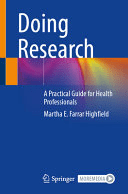
New book: “Doing Research: A Practical Guide”

Author: Martha “Marty” E. Farrar Highfield

NOW AVAILABLE ELECTRONICALLY & SOON IN PRINT.

CHECK OUT: https://link.springer.com/book/10.1007/978-3-031-79044-7

This book provides a step-by-step summary of how to do clinical research. It explains what research is and isn’t, where to begin and end, and the meaning of key terms. A project planning worksheet is included and can be used as readers work their way through the book in developing a research protocol. The purpose of this book is to empower curious clinicians who want data-based answers.

Doing Research is a concise, user-friendly guide to conducting research, rather than a comprehensive research text. The book contains 12 main chapters followed by the protocol worksheet. Chapter 1 offers a dozen tips to get started, Chapter 2 defines research, and Chapters 3-9 focus on planning. Chapters 10-12 then guide readers through challenges of conducting a study, getting answers from the data, and disseminating results. Useful key points, tips, and alerts are strewn throughout the book to advise and encourage readers.

PICOT: The same & Not the Same

Writing out your clinical question using the acronym PICOT may be different depending on whether you are planning to

  • do research (fill gaps in our knowledge) or
  • find & use best evidence in practice (EBP/evidence-based practice).

PICOT stands for Population, Intervention, Comparison intervention, Outcome to be measured, and Timing of the measurement. The reason that PICOT is sometimes written a bit differently for research than for EBP projects is that PICOT is used to generate the most helpful literature search terms.

RESEARCH vs. EBP PICOT-

  • In research you may be testing a very specific intervention because available evidence allows you to predict what intervention might be helpful. That means you want to specify the particular intervention (I) in which you are interested.
  • In EBP you may want to find out if an effective intervention for the problem already exists? And if so, what is it? That means when writing PICOT, you should NOT specify the I (intervention). Identify the P (population) and O (desired outcome), but for I (intervention) use a general term like “methods,” “techniques,” “strategies,” and so on. This will give you a richer overview of what others tested already. [Note: If you are finding literature that suggests a particular intervention is most effective, you might decide to insert that particular intervention in your PICOT and hence in your search terms.]

PRACTICE: Pick a clinical problem that is bugging you and try out an EBP PICOT vs a research PICOT. Compare results.

REFERENCE & FOR MORE: Check out https://libraryguides.nau.edu/c.php?g=665927&p=4682772

“Here comes Santa Claus”: What’s the evidence?

FULL TEXT ONLINE: Adv Emerg Nurs J. 2011 Oct-Dec;33(4):354-8. doi: 10.1097/TME.0b013e318234ead3. [note: Below is full text excerpt from AENJ summary was published in DYIS blog 16 Dec 2016]

Abstract

The purpose of this article is to examine the strength of evidence regarding our holiday Santa Claus (SC) practices and the opportunities for new descriptive, correlation, or experimental research on SC. Although existing evidence generally supports SC, in the end we may conclude, “the most real things in the world are those that neither children nor men can see” (Church, as cited in Newseum, n.d.).

ARE HOLIDAY Santa Claus (SC) activities evidence based? This is a priority issue for those of us who’ve been nice, not naughty. In this article, I review the strength of current evidence supporting the existence of SC, discuss various applications of that evidence, and suggest new avenues of investigation.

[continue reading at 10.1097/TME.0b013e318234ead3]

What is Nursing Science?

Recently nurse scientists were asked that question. Here are a few responses. For more see: https://www.aacnnursing.org/news-data/research-data-center/phd-data/meet-nurse-researchers-and-teams

Historical research in healthcare: Free, zoom forums from UVA

“Hospital City, Health Care Nation: Race, Capital, and the Costs of American Health Care”Guian McKee, PhD
Tuesday, September 12, 2023
 12 p.m. (ET) on Zoom
Hosted by the UVA Bjoring Center for Nursing Historical InquiryZoom link: https://virginia.zoom.us/j/95756992198?pwd=TEZQNmVjOGxENmdCUlZFUGtWa3Ztdz09 Meeting ID: 957 5699 2198Passcode: 355573
Dr. Guian McKee will speak about his new book, Hospital City, Health Care Nation, which recasts the story of the U.S. health care system by emphasizing its economic, social, and medical importance in American communities. Focusing on urban hospitals and academic medical centers, the book argues that the country’s high level of health care spending has allowed such institutions to become vital economic anchors for communities. Yet that spending has also constrained possibilities for comprehensive health care reform over many decades. At the same time, the role of hospitals in urban renewal, in community health provision, and as employers of low-wage workers has contributed directly to racial health disparities. McKee points to the increased role of financial capital after the 1960s in shaping not only hospital growth but also the underlying character of these vital institutions. The book shows how hospitals’ quest for capital has interacted with structural racism and inequality to constrain the U.S. health care system.
Dr. McKee is a professor of presidential studies at the UVA Miller Center. He is co-chair of the Presidential Recordings Program and co-directs its Health Care Policy Project. His 2023 book, Hospital City, Health Care Nationis available through the University of Pennsylvania Press.  We hope you can tune in! Maura Singleton
Center Manager
Eleanor Crowder Bjoring Center for Nursing Historical Inquiry

mks2d@virginia.edu
P 434.924.0083; 434.989.1550 (cell)

UVA School of Nursing
202 Jeanette Lancaster Way
P.O. Box 800782
Charlottesville, VA 22908-0782

www.nursing.virginia.edu/nursing-history/

Primer on Design: Part 3 – Mixing UP Methods

QUICK REVIEW: Research design is the overall plan for a study. And…there are 2 main types of design: 1) Non-experiments in which the researcher observes and documents what exists,

and 2) Experiments when the researcher tries out an intervention and measures outcomes.

NEW INFO: Two non-experimental research designs that are often confused with one another are: 1) cohort studies & 2) case studies. Epidemiologists often use these designs to study large populations.

In a cohort study, a group of participants, who were exposed to a presumed cause of disease or injury, are followed into the future (prospectively) to identify emerging health issues. Researchers may also look at their past (retrospectively) to determine the amount of exposure that is related to health outcomes.

In contrast, in a case controlled study, participants with a disease or condition (cases) and others without it (controls) are followed retrospectively to compare their exposure to a presumed cause.

EXAMPLES?

  1. Martinez-Calderon et al (2017 ) Influence of psychological factors on the prognosis of chronic shoulder pain: protocol for a prospective cohort study. BMJ Open, 7. doi: 10.1136/bmjopen-2016-012822
  2. Smith et al (2019). An outbreak of hepatitis A in Canada: The use of a control bank to conduct a case-control study. Epidemiology & Infection, 147. doi: https://doi.org/10.1017/S0950268819001870

CRITICAL THINKING: Do you work with a group that has an interesting past of exposure to some potential cause of disease or injury? Which of the above designs do you find more appealing and why?

The Whole Picture: Mixed Methods Design

Idea2Mixed methods (MM) research provides a more complete picture of reality by including both complementary quantitative and qualitative data.


A clinical analogy for MM research is asking patients to rate their pain numerically on a 0–10 scale and then to describe the pain character in words.

MM researchers sometimes include both experimental hypotheses and non-experimental research questions in the same study.

writing article

Common MM subtypes are in the below table. In concurrent designs investigators collect all data at the same time, and in sequential designs they collect one type of data before the other. In triangulated MM, data receive equal weight, but in embedded designs, such as a large RCT in which only a small subset of RCT participants are interviewed, the main study data is weighted more heavily. In sequential MM, researchers give more weight to whatever type of data were collected first; for exploratory this is qualitative data and for explanatory it is quantitative data.

FOR MORE INFO: WHAT IS MIXED METHODS RESEARCH? – Dr. John Creswell

MM DESIGNEQUALLY WEIGHTED DATAPRIORITY WEIGHTED DATA
Concurrent data collection:
*Triangulation
All data
*EmbeddedMain study data
Sequential data collection:
*Exploratory
Qualitative data
*ExplanatoryQuantitative data
TYPES OF MM DESIGN: Concurrent & Sequential

New research: Mindfulness

Check out the newest and add your critique in comments.

“Evidence suggests that mindfulness training using a phone application (app) may support neonatal intensive care unit (NICU) nurses in their high stress work.” https://journals.lww.com/advancesinneonatalcare/Abstract/9900/The_Effect_of_a_Mindfulness_Phone_Application_on.63.aspx

The Effect of a Mindfulness Phone Application on NICU Nurses’ Professional Quality of Life

by Egami, Susan MSN, RNC-NIC, IBCLC; Highfield, Martha E. Farrar PhD, RN

Editor(s): Dowling, Donna PhD, RN, Section Editors; Newberry, Desi M. DNP, NNP-BC, Section Editors; Parker, Leslie PhD, APRN, FAAN, Section EditorsAuthor Information

Advances in Neonatal Care ():10.1097/ANC.0000000000001064, April 10, 2023. | DOI: 10.1097/ANC.0000000000001064

Correlation Studies: Primer on Design Part 2

REMEMBER:

Research design = overall plan for a study.

The 2 major categories of research study design are:

  1. Non-experimental, observation-only studies, &
  2. Experimental testing of an intervention studies.

Correlation study designs are in that first category. Correlation studies focus on whether changes in at least one variable are statistically related to changes in another. In other words, do two or more variables change at the same time.

Such studies do not test whether one variable causes change in the other. Instead they are analogous to the chicken-and-egg dilemma in which one can confirm that the number of chickens and eggs are related to each other, but no one can say which came first or which caused the other. Correlation study questions may take this form, “Is there a relationship between changes in [variable x] and changes in [variable y]?” while a correlation hypothesis might be a prediction that, “As [variable x] increases, [variable y] decreases.”

An example of a question appropriate to this design is, “Are nurses’ age and educational levels related to their professional quality of life?” Sometimes a yet-unidentified, mediating variable may be creating the changes in one or all correlated variables. For example, rising nurse age and education may make them likely to choose certain work settings with high professional quality of life; this means the mediating variable of work setting—not age or education—might be creating a particular professional quality of life.

Alert! Correlation is not causation.