Tag Archives: research

“Here comes Santa Claus”: What’s the evidence?

Dec 3, 2025: It’s time once again to examine the evidence. How will you apply it in your Christmas practice?

FULL TEXT ONLINE: Adv Emerg Nurs J. 2011 Oct-Dec;33(4):354-8. doi: 10.1097/TME.0b013e318234ead3. [note: Below is full text excerpt from AENJ summary was published in DYIS blog 16 Dec 2016]

Abstract

The purpose of this article is to examine the strength of evidence regarding our holiday Santa Claus (SC) practices and the opportunities for new descriptive, correlation, or experimental research on SC. Although existing evidence generally supports SC, in the end we may conclude, “the most real things in the world are those that neither children nor men can see” (Church, as cited in Newseum, n.d.).

ARE HOLIDAY Santa Claus (SC) activities evidence based? This is a priority issue for those of us who’ve been nice, not naughty. In this article, I review the strength of current evidence supporting the existence of SC, discuss various applications of that evidence, and suggest new avenues of investigation.

[continue reading at 10.1097/TME.0b013e318234ead3]

Essentials for Clinical Researchers

[note: bonus 20% book discount from publisher. See below flyer]

My 2025 book, Doing Research, is a user-friendly guide, not a comprehensive text. Chapter 1 gives a dozen tips to get started, Chapter 2 defines research, and Chapters 3-9 focus on planning. The remaining Chapters 10-12 guide you through challenges of conducting a study, getting answers from the data, and sharing with others what you learned. Italicized key terms are defined in the glossary, and a bibliography lists additional resources.

Theoretically speaking…is this all “pie-in-the-sky” stuff?

Is using theory and conceptual frameworks in studies just “pie-in-the-sky” stuff? Do they have any practical use? Or are they merely for academics in ivory towers?

This blog about theory-testing research1 may affect your answers.

What is it? At its most basic, theory or framework is a set of statements that describe part of reality. Those related statements (called propositions) outline the relationship between two or more ideas (called concepts). One example of a set of propositions is: “Work stress leads to burnout; burnout leads to poor work outcomes; mindfulness practice leads to lower burnout and thus to better work outcomes.” These statements describe the relationships between concepts of “work stress,” “burnout,” “poor work outcomes,” and “mindfulness practice.”

Each concept has 1) an abstract dictionary-type, conceptual definition & 2) a concrete, measurable, operational definition. For example, Maslach conceptually defined burnout as a combination of emotional exhaustion, depersonalization, and lower personal accomplishment; then those concepts are operationally defined as a self-reported burnout score on Maslach’s Burnout Inventory (MBI).

Some theories are named for their authors–like Einstein’s theory of relativity expressed in a single proposition about the relationship between concepts of energy, mass, & speed of light. Einstein’s theory & propositions of other theory/frameworks describe our existing knowledge about a topic based on evidence and logical connections.

To connect your study with such existing knowledge, take these steps:

1) Identify a theory/framework that conceptually & operationally defines your concept of interest and states its relationship to other concepts. Start by looking in the library for articles on your topic.

2) Accept most of the theory/framework’s propositions as true without testing them yourself (called assumptions). All studies assume a lot to be true already–meaning they have a lot of assumptions. It’s the way science works because you can’t test everything at once.

3) Identify a proposition that you want to test, and write it in a testable form as a hypotheses or research questions. You will be testing only a tiny piece of the theory/framework, perhaps by examining the concepts in a new setting, with new methods, or in a different or larger sample. For example, you might want to test an intervention to see if it reduces burnout (e.g., Hypothesis: “ICU staff using a mindfulness phone app will report lower burnout than those who do not use the app.”)

4) When your study is complete, discuss how your findings confirm or disconfirm the theory/framework. Your logic and research are now a part of what we know (or think we know).

Conclusion: Of course there’s much more that could be said on this topic. Let me know what to add in the comments. -Dr.H

Questions for thot:

So, do you think theory/conceptual frameworks are just “pie in the sky” without practical value? If so, how would you build a study on existing knowledge? If you think they ARE practical, how would you use them to study your topic of interest? Explain how you have or have not used propositions in a study.


  1. Theory-building research is a different inductive path. Theory-testing is more deductive. ↩︎

A Dozen Tips to Start

If you are new to research, there are a few things you should know going in. For some of these, check out Chapter 1 of Doing Research: A practical guide for health professionals.

Chapter 1 notes 12 tips and tricks for beginning researchers to start and finish a clinical research study. Three are to take baby steps, to consider descriptive research as your first project, and to use a protocol template from an institutional review board (IRB) to plan your study.

Check out the book, or my earlier blogpost that is a primer on descriptive studies earlier blog post, or “read sample” from Doing Research on amazon.com

Happy discovering!

Highfield, M.E.F. (2025). A Dozen Tips to Start. In: Doing Research. Springer, Cham. https://doi.org/10.1007/978-3-031-79044-7_1

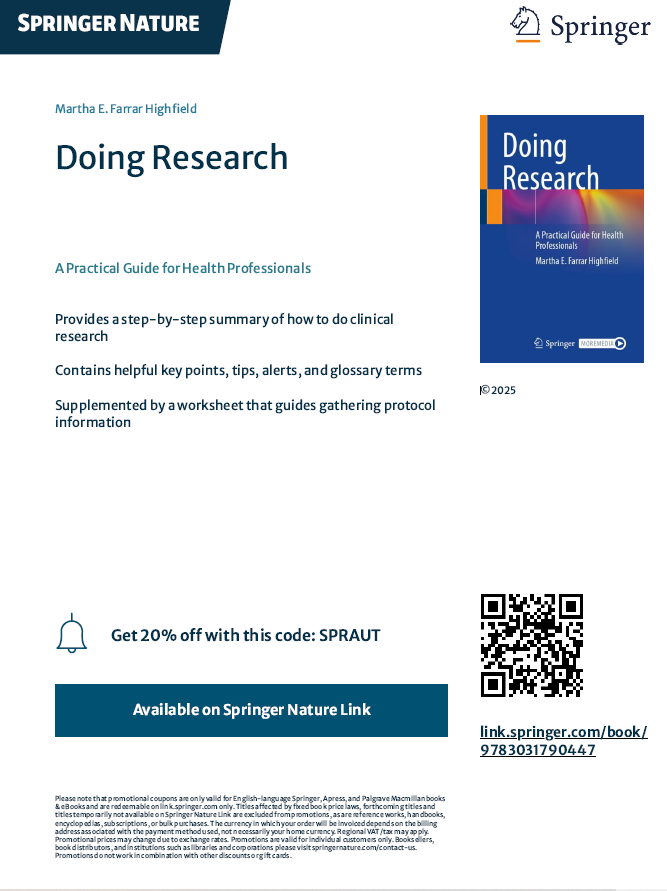
New book: “Doing Research: A Practical Guide”

Author: Martha “Marty” E. Farrar Highfield

NOW AVAILABLE ELECTRONICALLY & SOON IN PRINT.

CHECK OUT: https://link.springer.com/book/10.1007/978-3-031-79044-7

This book provides a step-by-step summary of how to do clinical research. It explains what research is and isn’t, where to begin and end, and the meaning of key terms. A project planning worksheet is included and can be used as readers work their way through the book in developing a research protocol. The purpose of this book is to empower curious clinicians who want data-based answers.

Doing Research is a concise, user-friendly guide to conducting research, rather than a comprehensive research text. The book contains 12 main chapters followed by the protocol worksheet. Chapter 1 offers a dozen tips to get started, Chapter 2 defines research, and Chapters 3-9 focus on planning. Chapters 10-12 then guide readers through challenges of conducting a study, getting answers from the data, and disseminating results. Useful key points, tips, and alerts are strewn throughout the book to advise and encourage readers.

New Book Strives to Make the Difficult Simple

Doing Research: A practical guide for health professionals, a new book by Martha E. Farrar Highfield is in press Springer Nature. Release date Feb 1, 2025 (preorder available).

Practical, brief, and affordable, Doing Research is for residents, nurses, chaplains, and other clinicians.

Written in informal, friendly style, this book makes the difficult simple.

The purpose of Doing Research is to empower curious clinicians to conduct research alongside a mentor, even when they lack prior research experience or formal training.

Doing Research presents practical steps for conducting a study from beginning to end. It begins with “a dozen tips” to get started, then moves to study planning, conduct, and dissemination of results. A worksheet to write your research plan (protocol) is included. Research terms and process are explained, including what research is and is not. Tips & Alerts provide a “reassuring voice,” as well as alerting readers to common missteps.

PICOT: The same & Not the Same

Writing out your clinical question using the acronym PICOT may be different depending on whether you are planning to

  • do research (fill gaps in our knowledge) or
  • find & use best evidence in practice (EBP/evidence-based practice).

PICOT stands for Population, Intervention, Comparison intervention, Outcome to be measured, and Timing of the measurement. The reason that PICOT is sometimes written a bit differently for research than for EBP projects is that PICOT is used to generate the most helpful literature search terms.

RESEARCH vs. EBP PICOT-

  • In research you may be testing a very specific intervention because available evidence allows you to predict what intervention might be helpful. That means you want to specify the particular intervention (I) in which you are interested.
  • In EBP you may want to find out if an effective intervention for the problem already exists? And if so, what is it? That means when writing PICOT, you should NOT specify the I (intervention). Identify the P (population) and O (desired outcome), but for I (intervention) use a general term like “methods,” “techniques,” “strategies,” and so on. This will give you a richer overview of what others tested already. [Note: If you are finding literature that suggests a particular intervention is most effective, you might decide to insert that particular intervention in your PICOT and hence in your search terms.]

PRACTICE: Pick a clinical problem that is bugging you and try out an EBP PICOT vs a research PICOT. Compare results.

REFERENCE & FOR MORE: Check out https://libraryguides.nau.edu/c.php?g=665927&p=4682772

“Here comes Santa Claus”: What’s the evidence?

FULL TEXT ONLINE: Adv Emerg Nurs J. 2011 Oct-Dec;33(4):354-8. doi: 10.1097/TME.0b013e318234ead3. [note: Below is full text excerpt from AENJ summary was published in DYIS blog 16 Dec 2016]

Abstract

The purpose of this article is to examine the strength of evidence regarding our holiday Santa Claus (SC) practices and the opportunities for new descriptive, correlation, or experimental research on SC. Although existing evidence generally supports SC, in the end we may conclude, “the most real things in the world are those that neither children nor men can see” (Church, as cited in Newseum, n.d.).

ARE HOLIDAY Santa Claus (SC) activities evidence based? This is a priority issue for those of us who’ve been nice, not naughty. In this article, I review the strength of current evidence supporting the existence of SC, discuss various applications of that evidence, and suggest new avenues of investigation.

[continue reading at 10.1097/TME.0b013e318234ead3]

What is Nursing Science?

Recently nurse scientists were asked that question. Here are a few responses. For more see: https://www.aacnnursing.org/news-data/research-data-center/phd-data/meet-nurse-researchers-and-teams

Historical research in healthcare: Free, zoom forums from UVA

“Hospital City, Health Care Nation: Race, Capital, and the Costs of American Health Care”Guian McKee, PhD
Tuesday, September 12, 2023
 12 p.m. (ET) on Zoom
Hosted by the UVA Bjoring Center for Nursing Historical InquiryZoom link: https://virginia.zoom.us/j/95756992198?pwd=TEZQNmVjOGxENmdCUlZFUGtWa3Ztdz09 Meeting ID: 957 5699 2198Passcode: 355573
Dr. Guian McKee will speak about his new book, Hospital City, Health Care Nation, which recasts the story of the U.S. health care system by emphasizing its economic, social, and medical importance in American communities. Focusing on urban hospitals and academic medical centers, the book argues that the country’s high level of health care spending has allowed such institutions to become vital economic anchors for communities. Yet that spending has also constrained possibilities for comprehensive health care reform over many decades. At the same time, the role of hospitals in urban renewal, in community health provision, and as employers of low-wage workers has contributed directly to racial health disparities. McKee points to the increased role of financial capital after the 1960s in shaping not only hospital growth but also the underlying character of these vital institutions. The book shows how hospitals’ quest for capital has interacted with structural racism and inequality to constrain the U.S. health care system.
Dr. McKee is a professor of presidential studies at the UVA Miller Center. He is co-chair of the Presidential Recordings Program and co-directs its Health Care Policy Project. His 2023 book, Hospital City, Health Care Nationis available through the University of Pennsylvania Press.  We hope you can tune in! Maura Singleton
Center Manager
Eleanor Crowder Bjoring Center for Nursing Historical Inquiry

mks2d@virginia.edu
P 434.924.0083; 434.989.1550 (cell)

UVA School of Nursing
202 Jeanette Lancaster Way
P.O. Box 800782
Charlottesville, VA 22908-0782

www.nursing.virginia.edu/nursing-history/