Want to know the standardized format for writing up your research study, QI report, case study, systematic review, or clinical practice guideline? Check out these standardized reporting guidelines: http://www.equator-network.org/reporting-guidelines/
Of course you should always give priority to the author instructions for the particular journal in which you want to publish, but most adhere generally or fully to these standardized guides.
Want to know how to write an introduction/background section of a paper? Pay attention to STRUCTURE & evidence-based ARGUMENT in order to DIY (do-it-yourself) your own intro/background for a school paper or research report!
Focus only on the INTRO/BACKGROUND section for now. Check out the STRUCTURE then the EVIDENCE-BASED ARGUMENT of the Intro/Background. This is how you should write your own.
STRUCTURE of INTRO/BACKGROUND in Sørbø et al. (2015):
Where is the Intro/Background section located in the article?
What heading is used for the section?
Where are the research questionslocated in the Intro/Background? (HINT: this is the standard place in all papers & in this case the authors call them “aims.)
ARGUMENTS in INTRO/BACKGROUND in Sørbø et al. (2015):
Look at the first (topic) sentence of each paragraph in INTRO/BACKGROUND & listen to the systematic argument the researchers are making for WHY their study is important.
“Breast feeding has long been acknowledged as the optimal infant nutrition conferring beneficial short-term and long-term health effects for both infants and mothers.1–5 …
Abuse of women is common worldwide, as one in three women during lifetime suffer partner or non-partner abuse.10…Adverse effects [of abuse]… are barriers to breast feeding.*…
Given the overwhelming evidence of the positive effects of breast feeding, knowledge about factors influencing breastfeeding behaviour is essential….
We explored the impact of abuse of women on breastfeeding behaviour in a large prospective population in Norway where the expectations to breast feed are high, and breast feeding is facilitated in the work regulations….” (pp. 1-2)
Now look at the research & other evidence written down AFTER each of above key sentences that SUPPORT each idea.
Notice that the INTRO/BACKGROUND is NOT a series of abstracts of different studies!! Instead evidence is grouped into key arguments for the study: Breast feeding is best, Abuse is common, Abuse creates barriers to breastfeeding, & Therefore, knowing about factors affecting breastfeeding is important). [Note: Of course, if your particular professor or editor asks you to do a series of abstracts, then you must, but do group them in arguments like the topic sentences.]
All this leads naturally, logically to …(drum roll please!)…the research questions/hypotheses, which are the gaps in our knowledge that the research will fill. This sets up the rest of the research article!
Critical Thinking: Your turn! Write your own Intro/Background using
Structure:Placement in article, heading, placement of research question/hypothesis
Argument:Key idea topic sentences (make a list 1st) with supporting research & other evidence (your literature review).
Don’t be fooled. It’s a lot of work to prepare something to publish, and you want your work to appear in a credible source and be accessible. It’s YOUR reputation!
If you are a student search for literature, it is important to know this also!! You want to use the highest quality evidence you can find for your projects.
In honor of Nurse Week, I offer this tribute to the avant garde research work of Florence Nightingale in the Crimea that saved lives and set a precedent worth following.
Nightingale was a “passionate statistician” knowing that outcome data are convincing when one wants to change the world. She did not merely collect the data, but also documented it in a way that revealed its critical meaning for care.
As noted by John H. Lienhard (1998-2002): “Once you see Nightingale’s graph, the terrible picture is clear. The Russians were a minor enemy. The real enemies were cholera, typhus, and dysentery. Once the military looked at that eloquent graph, the modern army hospital system was inevitable. You and I are shown graphs every day. Some are honest; many are misleading….So you and I could use a Florence Nightingale today, as we drown in more undifferentiated data than anyone could’ve imagined during the Crimean War.” (Source: Leinhard, 1998-2002)
As McDonald (2001) writes in the BMJ free, full-text, Nightingale was “a systemic thinker and a “passionate statistician.” She insisted on improving care by making policy & care decisions based on “the best available government statistics and expertise, and the collection of new material where the existing stock was inadequate.”(p.68)
Moreover, her display of the data brought its message home through visual clarity!
Thus while Nightingale adhered to some well-accepted, but mistaken, scientific theories of the time (e.g., miasma) her work was superb and scientific in the best sense of the word. We could all learn from Florence.
CRITICAL THINKING: What issue in your own practice could be solved by more data? How could you collect that data? If you have data already, how can you display it so that it it meaningful to others and “brings the point home”?
Share your quality projects for sure! You learned from them & so can the larger community. Make your voice heard.
Let below encourage you to encourage you to publish, present, disseminate your quality improvement projects!!
Davidoff & Batalden in 2005 wrote these words that still apply today:
In contrast with the primary goals of science, which are to discover and disseminate new knowledge, the primary goal of improvement is to change performance. Unfortunately, scholarly accounts of the methods, experiences, and results of most medical quality improvement work are not published, either in print or electronic form. In our view this failure to publish is a serious deficiency: it limits the available evidence on efficacy, prevents critical scrutiny, deprives staff of the opportunity and incentive to clarify thinking, slows dissemination of established improvements, inhibits discovery of innovations, and compromises the ethical obligation to return valuable information to the public.The reasons for this failure are many: competing service responsibilities of and lack of academic rewards for improvement staff; editors’ and peer reviewers’ unfamiliarity with improvement goals and methods; and lack of publication guidelines that are appropriate for rigorous, scholarly improvement work. We propose here a draft set of guidelines designed to help with writing, reviewing, editing, interpreting, and using such reports. We envisage this draft as the starting point for collaborative development of more definitive guidelines. We suggest that medical quality improvement will not reach its full potential unless accurate and transparent reports of improvement work are published frequently and widely.
Critical thinking: What is a QI project on your unit in which others might be interested? Sketch out an outline using headings recommended here: http://ocpd.med.umich.edu/moc-qi/presenting-publishing-qi
For more Infosee Davidoff & Batalden. (2005). Toward stronger evidnece on quality improvment. Draft publication guidelines: the beginning of a consensus project. Quality & Safety in Health Care, 14, 319-32.doi:10.1136/qshc.2005.014787
Correspondence to: Dr F Davidoff 143 Garden Street, Wethersfield, CT 06109, USA; fdavidoff@cox.net
You should have the goal of disseminating a project that will help others. Just trying to publish “something” won’t take you far. Figure out the unique twist of your ideas. Talk it over with colleagues & see what they find interesting.
Write a query email to each journal to see if they are interested. NOTE: some journals will tell you what format your query should follow. You can write as many query letters as you want.
Pick a journal from those interested. YOU CAN SUBMIT YOUR ARTICLE TO ONLY 1 JOURNAL at a time. If that journal rejects you can then submit to 1 other, and so on.
Edit your paper with that journal’s audience in mind.
Get a peer to read thoroughly and critique your article! THEN you have to LISTEN to all their concerns. If something is unclear to a peer, it will probably be unclear to a peer-reviewer.
Format & submit EXACTLY, EXACTLY as they ask on the journal instructions to authors. (If you want to annoy editors and reviewers just ignore their instructions to potential authors.)
Wait & keep your fingers crossed
If they turn back to you for revisions that is a GOOD SIGN. It means they’re interested and you should address every concern.
Resubmit
FOR MORE INFORMATION: Check our Nurse Author & Editor for sure! http://naepub.com/
Join the Honor Society of Nursing, Sigma Theta Tau International and more than 2,000 of your peers in Indianapolis, Indiana, USA, 28 October – 1 November 2017, for the 44th Biennial Convention. Experience STTI’s largest event, which features more than 800 oral and poster presentations, networking opportunities, and more.
Call for Abstracts Opportunities are now available to submit abstracts for the 44th Biennial Convention.
Submission Deadline: 9 November 2016.
Ok, so you found some GREAT, new & improved clinical guidelines that exactly fit the problem that you are trying to solve on your unit. Now What??? How do you get from the guidelines from paper to practice? & How do you know that the guidelines are any good any way? Where are the tools for all this?
Like the old cartoon Mighty Mouse, here comes the Registered Nurses Association of Ontario to save the day! (cue the music) You can download a FREE toolkit. Yes, that’s right. FREE.
It comes complete with examples & step-by-step instructions. Check it out! And if I haven’t been persuasive enough, here’s the table of contents! This is waaay cooool. Don’t miss it.
Congratulations—You and your team have completed a project!
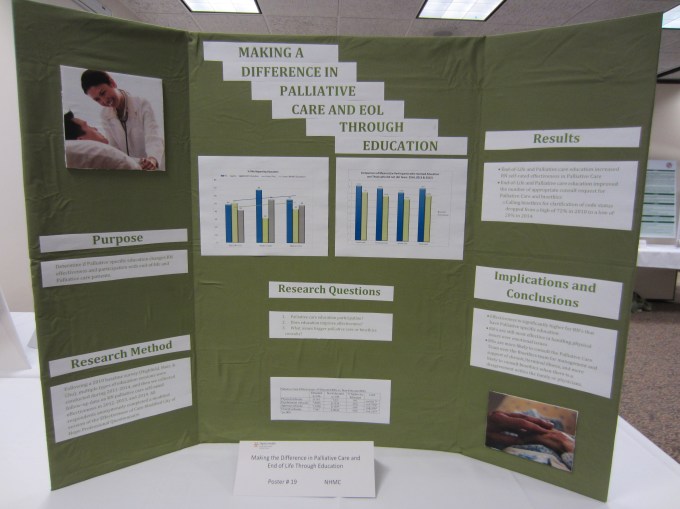
Now what? Disseminate your work of course so that others can learn. A poster is a great way to do this. Dissemination is a key step in research & evidence-based practice.
But how should you present the information on your poster?To quote a well-known
politician: “What difference does it make” how you present your project in a poster. Quite a bit, it turns out! Some posters are definitely better than others.
For your poster you want to realize that you are dealing with a VISUAL medium, not text. This means that you need:
A CLEAR FOCUSon the key ideas & results
CONTENT THAT FLOWS. You want to make sure the reader is guided through the poster–maybe by numbering steps or adding arrows.
Enough “WHITE SPACE” that the readers eye has time to “rest” and that draws attention to your focus. (e.g., think “Got Milk?” in bold white letters on a black background. White space =any color blank space.)
USE VISUAL– Employ short phrases, bullet points, active voice, and graphics that take advantage of the visual medium. Some people say 50% should be graphics.
OK
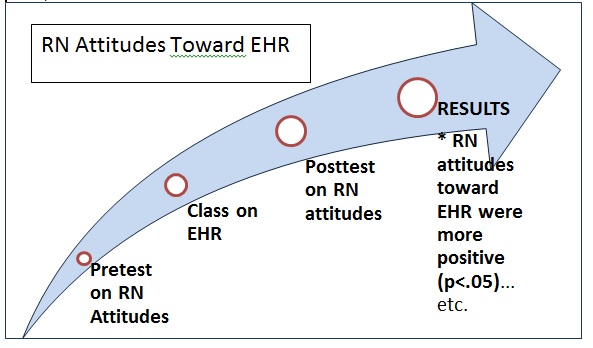
For example, let’s look at 3 different ways that you could present your pretend research study on RN attitudes to electronic health records (EHR). The NOVICE POSTER-MAKER may put the following on their poster:
“RN attitudes toward the new electronic health record were examined in a pretest, and class was taught on how to use the electronic health record. After the class a posttest of their attitudes was conducted.”
The above example has several problems! It is in passive voice. It has too many extra words. It is plain text and not the visual. It doesn’t give results. Is someone going to stand there and read your poster like an article? Nope. You need to make it different!
To make a difference, TRY THIS SOLUTIONto present the same information as bullet point phrases:
Better?
Key variable: RN attitudes toward electronic health record (EHR)
Pretest of RN attitudes to EHR
Class on improved use
Posttest of RN attitudes toward EHR showed improvement (p<.05)
Best?
OR PERHAPS TO MAKE AN EVEN BETTER DIFFERENCE—KEEP IT REALLY VISUAL, WITH FLOW AND FOCUS (using graphics when possible instead of words)

 case study, systematic review, or clinical practice guideline? Check out these standardized reporting guidelines: http://www.equator-network.org/reporting-guidelines/





 “Once you see Nightingale’s graph, the terrible picture is clear. The Russians were a minor enemy. The real enemies were cholera, typhus, and dysentery. Once the military looked at that eloquent graph, the modern army hospital system was inevitable. You and I are shown graphs every day. Some are honest; many are misleading….So you and I could use a Florence Nightingale today, as we drown in more undifferentiated data than anyone could’ve imagined during the Crimean War.” (Source: Leinhard, 1998-2002)





 FOR MORE INFORMATION: Check our Nurse Author & Editor for sure! http://naepub.com/

 Ok, so you found some GREAT, new & improved clinical guidelines that exactly fit the problem that you are trying to solve on your unit. Now What??? How do you get from the guidelines from paper to practice? & How do you know that the guidelines are any good any way? Where are the tools for all this?




 present your project in a poster. Quite a bit, it turns out! Some posters are definitely better than others.
 Critique this poster or another using the “60 second poster evaluation” at