Category Archives: Publishing

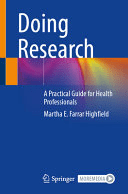
New book: “Doing Research: A Practical Guide”

Author: Martha “Marty” E. Farrar Highfield

NOW AVAILABLE ELECTRONICALLY & SOON IN PRINT.

CHECK OUT: https://link.springer.com/book/10.1007/978-3-031-79044-7

This book provides a step-by-step summary of how to do clinical research. It explains what research is and isn’t, where to begin and end, and the meaning of key terms. A project planning worksheet is included and can be used as readers work their way through the book in developing a research protocol. The purpose of this book is to empower curious clinicians who want data-based answers.

Doing Research is a concise, user-friendly guide to conducting research, rather than a comprehensive research text. The book contains 12 main chapters followed by the protocol worksheet. Chapter 1 offers a dozen tips to get started, Chapter 2 defines research, and Chapters 3-9 focus on planning. Chapters 10-12 then guide readers through challenges of conducting a study, getting answers from the data, and disseminating results. Useful key points, tips, and alerts are strewn throughout the book to advise and encourage readers.


Free, virtual seminar: How to publish in peer review journal

This Wiley sponsored online seminar should provide good information on how to disseminate your project findings!

Click here: How to publish in a peer reviewed journal

To Italicize or NOT to Italicize. That is the question.

So…after you do research or finish out your evidence-based practice project, you have to disseminate your findings, right?  That means good writing skills are necessary.

I stumbled into the GRAMMAR PARTY blog today when I wondered whether or not to italicize coup d’état. Do you know?  I didn’t.  Check out this helpful resource.


Write Away!

Want to know the standardized format for writing up your research study, QI report, Writing1case study, systematic review, or clinical practice guideline?    Check out these standardized reporting guidelines: http://www.equator-network.org/reporting-guidelines/

Of course you should always give priority to the author instructions for the particular journal in which you want to publish, but most adhere generally or fully to these standardized guides.

Write away!

?Trustworthy? Protect Your Reputation!

If you are writing something for publication, watch this 2 minute video before selecting a journal!   You’ll thank yourself for doing it.

  1. Thinkthinker
  2. Check
  3. Submit

< 2 minute video that tells you how to think, check, submit:  

  http://thinkchecksubmit.org/

Don’t be fooled.   It’s a lot of work to prepare something to publish, and you want your work to appear in a credible source and be accessible.   It’s YOUR reputation!

If you are a student search for literature, it is important to know this also!!  You want to use the highest quality evidence you can find for your projects.

A FAB resource if you want to let your light shine: Writing for publication

sunshineWant to write for publication?   CHECK OUT NURSE AUTHOR & EDITOR as one of the best places to learn to improve your writing:  http://naepub.com/


A few suggestions from me

  1. You should have the goal of disseminating a project that will help others. Just trying to publish “something” won’t take you far.   Figure out the unique twist of your ideas.  Talk it over with colleagues & see what they find interesting.
  2. Select as many journals from this list or other lists that you think might be interested:    https://nursingeditors.com/journals-directory/
  3. Write a query email to each journal to see if they are interested.  NOTE: some journals will tell you what format your query should follow.  You can write as many query letters as you want.
  4. Pick a journal from those interested.   YOU CAN SUBMIT YOUR ARTICLE TO ONLY 1 JOURNAL at a time.  If that journal rejects you can then submit to 1 other, and so on.
  5. Edit your paper with that journal’s audience in mind.writing-hand
  6. Get a peer to read thoroughly and critique your article!  THEN you have to LISTEN to all their concerns.  If something is unclear to a peer, it will probably be unclear to a peer-reviewer.
  7. Format & submit EXACTLY, EXACTLY as they ask on the journal instructions to authors.  (If you want to annoy editors and reviewers just ignore their instructions to potential authors.)
  8. Wait & keep your fingers crossed
  9. If they turn back to you for revisions that is a GOOD SIGN.  It means they’re interested and you should address every concern.
  10. Resubmit

question1FOR MORE INFORMATION: Check our Nurse Author & Editor for sure! http://naepub.com/