Category Archives: Literature review

Zotero!!

No. Zotero is not a shout like “Cowabunga!” Nor is Zotero the little brother of Zoro, the masked cowboy hero.

ZoteroBib is a free, online tool that quickly formats references into the right style–whether that style be APA, Chicago, or 10,000+ other available formats. Once it generates the formatted reference you can manually correct any mistakes.

To use ZoteroBib go to zbib.org, enter reference info, and select your desired format. You can create an entire bibliography, and then create an editable rtf copy and paste that bibliography into your own paper. ZoteroBib also facilitates insertion of footnotes in the text, including specific reference page #’s for quotes.

You need enter only your reference’s doi or URL or PMID to generate the whole, properly formatted reference. Or you can enter more article/source information.

Here’s a sparkling water toast to well-formatted and well-footnoted papers!

[Special thanks to Librarian Marcia Henry at CSU/Northridge who made me aware of this tool.]

Essentials for Clinical Researchers

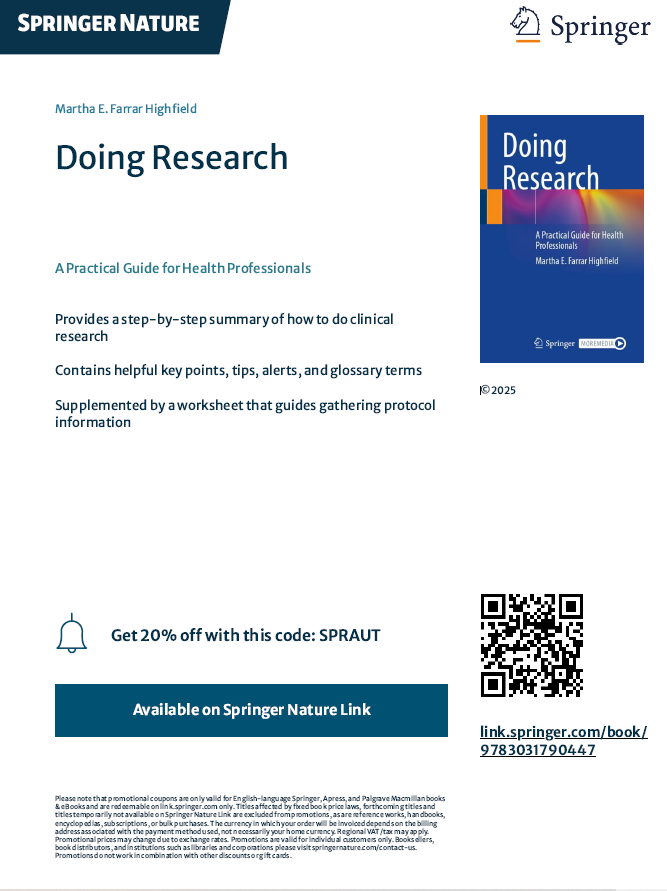
[note: bonus 20% book discount from publisher. See below flyer]

My 2025 book, Doing Research, is a user-friendly guide, not a comprehensive text. Chapter 1 gives a dozen tips to get started, Chapter 2 defines research, and Chapters 3-9 focus on planning. The remaining Chapters 10-12 guide you through challenges of conducting a study, getting answers from the data, and sharing with others what you learned. Italicized key terms are defined in the glossary, and a bibliography lists additional resources.

Five(5) great AI tools for research: Using without hallucinating

AI is getting better at 1) organizing information & 2) making suggestions for planning and writing research.

1st—a word of warning: Always verify AI-generated content USING YOUR OWN KNOWLEDGE!! Otherwise you’ll likely have AI hallucinations–content that is wrong, deceptive, or just plain nonsense. Scary!

Marek Kiczkowiak (speaker in below video) gives the AI-research-assistant gold medal to SCISPACE . AI SCISPACE bills itself as “The Fastest Research Platform Ever: All-in-one AI tools for students and researchers.” It performs a host of tasks, including creating slides from your paper. Other AI tools, like jenni or ResearchRabbit do some things better or differently. Watch this informative video, & try the tools.

What ethics questions does this raise? Two are: 1) questions of plagiarism (stealing) and 2) questions of how much YOU are learning when being AI-assisted.

Publishers are beginning to ask authors to what extent (if any) AI was used in a submitted paper. Moreoever, caution about plagiarizing is a cheap price for a clean conscience & learning what you need to learn. Hang onto those outcomes. “Above all else, guard your heart, for everything you do flows from it” -Proverb 4:23.

Here’s a second video for some help on avoiding plagiarism.

Your thots?

———————————————————–

Also, check out my 2025 book Doing Research (~100pp) that is written to help make the difficult simple.

[Best place to purchase now is this link: Springer. Amazon is stocking it erratically for reasons mysterious to the publisher.]

New book: “Doing Research: A Practical Guide”

Author: Martha “Marty” E. Farrar Highfield

NOW AVAILABLE ELECTRONICALLY & SOON IN PRINT.

CHECK OUT: https://link.springer.com/book/10.1007/978-3-031-79044-7

This book provides a step-by-step summary of how to do clinical research. It explains what research is and isn’t, where to begin and end, and the meaning of key terms. A project planning worksheet is included and can be used as readers work their way through the book in developing a research protocol. The purpose of this book is to empower curious clinicians who want data-based answers.

Doing Research is a concise, user-friendly guide to conducting research, rather than a comprehensive research text. The book contains 12 main chapters followed by the protocol worksheet. Chapter 1 offers a dozen tips to get started, Chapter 2 defines research, and Chapters 3-9 focus on planning. Chapters 10-12 then guide readers through challenges of conducting a study, getting answers from the data, and disseminating results. Useful key points, tips, and alerts are strewn throughout the book to advise and encourage readers.

PICOT: The same & Not the Same

Writing out your clinical question using the acronym PICOT may be different depending on whether you are planning to

  • do research (fill gaps in our knowledge) or
  • find & use best evidence in practice (EBP/evidence-based practice).

PICOT stands for Population, Intervention, Comparison intervention, Outcome to be measured, and Timing of the measurement. The reason that PICOT is sometimes written a bit differently for research than for EBP projects is that PICOT is used to generate the most helpful literature search terms.

RESEARCH vs. EBP PICOT-

  • In research you may be testing a very specific intervention because available evidence allows you to predict what intervention might be helpful. That means you want to specify the particular intervention (I) in which you are interested.
  • In EBP you may want to find out if an effective intervention for the problem already exists? And if so, what is it? That means when writing PICOT, you should NOT specify the I (intervention). Identify the P (population) and O (desired outcome), but for I (intervention) use a general term like “methods,” “techniques,” “strategies,” and so on. This will give you a richer overview of what others tested already. [Note: If you are finding literature that suggests a particular intervention is most effective, you might decide to insert that particular intervention in your PICOT and hence in your search terms.]

PRACTICE: Pick a clinical problem that is bugging you and try out an EBP PICOT vs a research PICOT. Compare results.

REFERENCE & FOR MORE: Check out https://libraryguides.nau.edu/c.php?g=665927&p=4682772

What’s in a Name?

[this posting back by popular demand]

TITLES!! That’s what you get when you search for research online!

But, whether your search turns up 3 or 32,003 article titles….remember that a title tells you a LOT In fact, if well-written it is a mini-abstract of the study. 

For example take this research article title “What patients with abdominal pain expect about pain relief in the Emergency Department” by Yee et al. in 2006 in JEN.
Variable (key factor that varies)?  Answer = Expectations about pain relief
Population studied? Answer = ED patients with abdominal pain
Setting? Answer = Maybe the ED (because they could’ve been surveyed after they got home or were admitted)
• Design?  Answer = not included, but you might guess that it is a descriptive study because it likely describes the patients’ expectations without any intervention.

There you have it! Now you know about TITLES!!

Now you try. Here’s your title: Gum chewing aids bowel function return and analgesic requirements after bowel surgery: a randomized controlled trial by Byrne CM, Zahid A, Young JM, Solomon MJ, Young CJ in May 2018

  • Variables? (this time there are 3 factors that vary–1 independent variable; & 2 dependent ones connected by “and”) Your answer is……
  • Population? (who is being studied; & if you have trouble identifying variables, identify the population first; then try) Your answer is….
  • Setting? (where; maybe not so clear; might have to go to abstract for this one) Your answer is….
  • Design of study? (it’s right there!) Your answer…..

Congratulate yourself!

Missing in Action: The Pyramid foundation

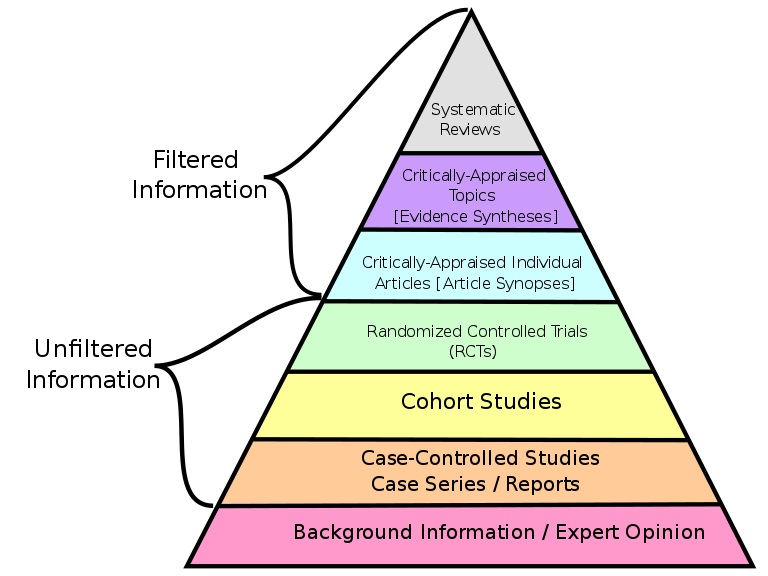
Last post I commented on the potentially misleading terms of Filtered & Unfiltered Filtered Unfiltered jpgresearch.  My key point?  Much so-called “unfiltered research” has been screened (filtered) carefully through peer-review before publication; while some “filtered research”  may have been ‘filtered’ only by a single expert & be out of date. If we use the terms filtered and unfiltered we should not be naive about their meanings. (Pyramid source:  Wikimedia Commons )

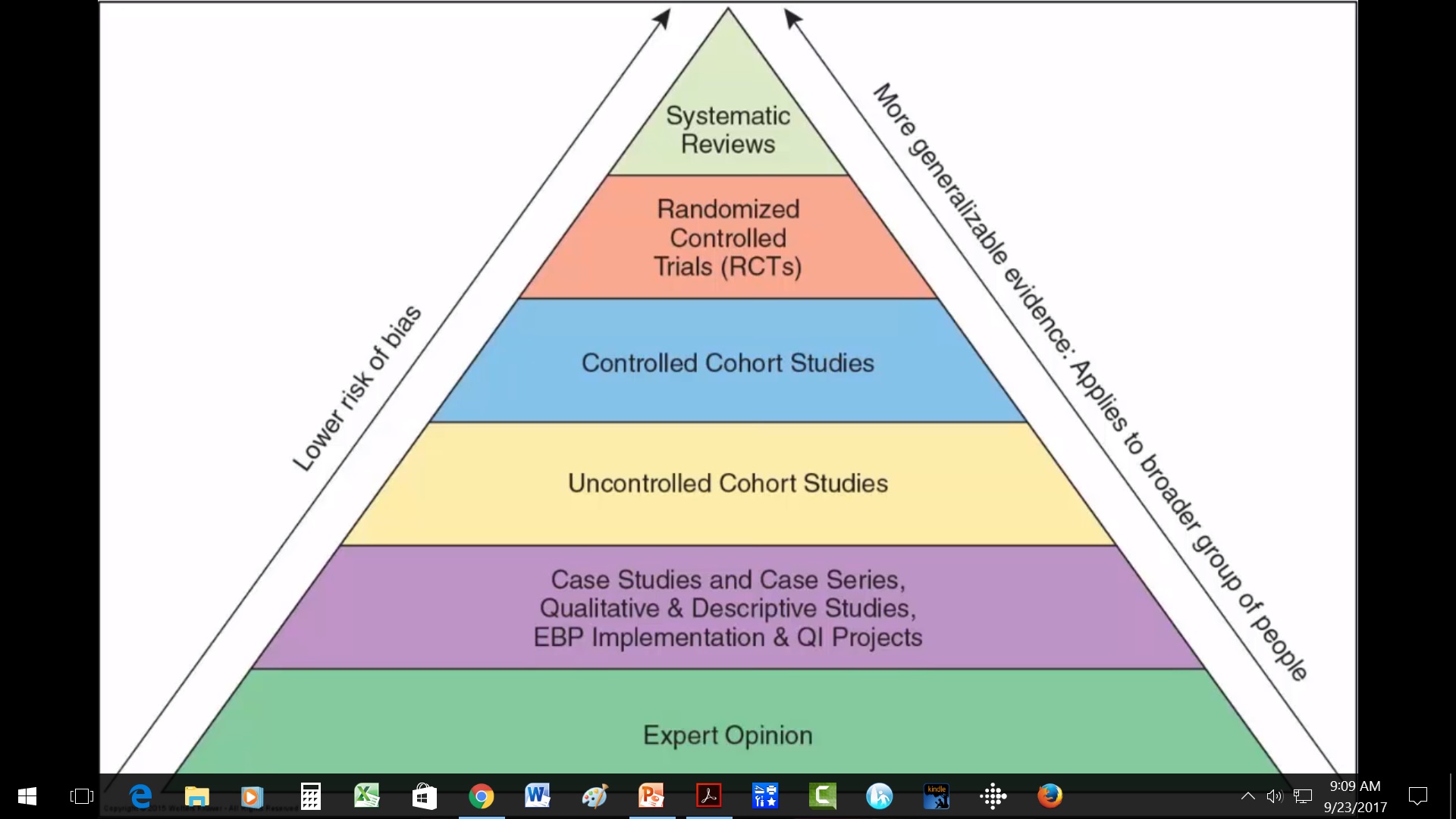
This week, I address what I see as a 2nd problem with this evidence based medicine pyramid.  That is, missing in action from it are descriptive, correlation, & in-depth qualitative research are not mentioned.  Where are they?  This undercuts the EBM pyramid as a teaching tool and also (intentionally or not) denigrates the necessary basic type of research on which stronger levels of evidence are built.  That foundation of the pyramid, called loosely “background information,” includes such basic, essential research.

Ask an ExpertYou may have heard of Benner’s Novice to Expert  theory.  Benner used in-depth, qualitative interview descriptions as data to generate her theory.  Yet that type of research evidence is missing from medicine’s pyramid!  Without a clear foundation the pyramid will just topple over.  Better be clear!

I recommend substituting (or at least adding to your repertoire) an Evidence Based NURSING (EBN) pyramid.  Several versions exist & one is below that includes some of the previously missing research!  This one includes EBP & QI projects, too! Notice the explicit addition of detail to the below pyramid as described at https://www.youtube.com/watch?v=MfRbuzzKjcM.EBN

Critical thinking:  #1List some EBM & EBN pyramid differences.  #2 Figure out where on the hierarchy this project would go: Crowell, J., OʼNeil, K., & Drager, L. (2017). Project HANDS: A bundled approach to increase short peripheral catheter dwell time. Journal of Infusion Nursing, 40(5), 274-280. doi: 10.1097/NAN.0000000000000237.   1st use medicine’s EBM pyramid; & then 2nd use nursing’s EBN pyramid.  #3 Label Crowell et al.’s study as filtered or unfiltered and explain what you mean by that.

For more info:  Watch the YouTube video at the link above.

Filtered vs. Unfiltered: What do these terms mean?

Are we talking cigarettes?  water? coffee? other?   Yes, other.   In this case about what is sometimes called “filtered” or “unfiltered” literature in the evidence-based medicine pyramid of research evidence.  (I have more than one issue with this particular pyramid as a representation of all evidence, but for right now let’s look at filtered information & unfiltered information.  Pyramid source:  Wikimedia Commons  
Filtered Unfiltered jpg

Filtered is considered stronger–meaning that we can be more confident that literature from this category better  supports cause and effect.  I agree.

Unfiltered evidence (usually single studies etc) is considered weaker–meaning that we must be more cautious about its accuracy in representing reality.  I agree.

But, “Is unfiltered information really unfiltered?”  No filtering at all? My qualified answer is, “No.”   Argue with me if you like.

My opinion: If the “unfiltered” article is a primary source, research study that has strong design and is published in a peer-review journal then it has been filtered by multiple, expert peer reviewers just to make it to publication.

Thus, when discussing filtered vs. unfiltered one should be very clear on what those terms mean and do not mean.

Critical Thinking: When filtered literature (systematic reviews & critically appraised topics & articles) has been filtered by one individual, is that superior to unfiltered literature in terms of introducing bias?  What if the “filtered” evidence is 7 years old and a primary, “unfiltered” source(s) from this year has different findings?   What is the relationship between “filtered” and “unfiltered”–after all the “unfiltered” is the pyramid base so what does that mean?

For more Info:  For peer review, the lower level filtering of single studies, consider its 1)  advantages (https://www.ncbi.nlm.nih.gov/pmc/articles/PMC4975196/)  and 2) its potential flaws (https://www.ncbi.nlm.nih.gov/pmc/articles/PMC1420798/)

DIY your own Intro/Background: Structure & Argument

Want to know how to write an introduction/background section of a paper?  Pay attention to STRUCTURE & evidence-based ARGUMENT in order to DIY (do-it-yourself) your own intro/background for a school paper or research report!

Let’s use this 2015 free full-text article by Marie Flem Sørbø et al. as a model!  Past and recent abuse is associated with early cessation of breast feeding: results from a large prospective cohort in Norway .   (Hint: Clicking on the article’s pdf tab may make it easier to read.)

Focus only on the INTRO/BACKGROUND section for now.  Check out the STRUCTURE then the EVIDENCE-BASED ARGUMENT of the Intro/Background.  This is how you should write your own.

STructure

STRUCTURE of INTRO/BACKGROUND in Sørbø et al. (2015):

  1. Where is the Intro/Background section located in the article?
  2. What heading is used for the section?
  3. Where are the research questions located in the Intro/Background?  (HINT: this is the standard place in all papers & in this case the authors call them “aims.)
Why2

ARGUMENTS in INTRO/BACKGROUND in Sørbø et al. (2015):

  1. Look at the first (topic) sentence of each paragraph in INTRO/BACKGROUND & listen to the systematic argument the researchers are making for WHY their study is important.
    • “Breast feeding has long been acknowledged as the optimal infant nutrition conferring beneficial short-term and long-term health effects for both infants and mothers.1–5      …
    • Abuse of women is common worldwide, as one in three women during lifetime suffer partner or non-partner abuse.10   …Adverse  effects [of abuse]… are barriers to breast feeding.*…
    • Given the overwhelming evidence of the positive effects of breast feeding, knowledge about factors influencing breastfeeding behaviour is essential….
    • We explored the impact of abuse of women on breastfeeding behaviour in a large prospective population in Norway where the expectations to breast feed are high, and breast feeding is facilitated in the work regulations….” (pp. 1-2)
      evidence2
  2. Now look at the research & other evidence written down AFTER each of above key sentences that SUPPORT each idea.
  3. Notice that the INTRO/BACKGROUND is NOT a series of abstracts of different studies!!  Instead evidence is grouped into key arguments for the study: Breast feeding is best, Abuse is common, Abuse creates barriers to breastfeeding, & Therefore, knowing about factors affecting breastfeeding is important). [Note: Of course, if your particular professor or editor asks you to do a series of abstracts, then you must, but do group them in arguments like the topic sentences.]

All this leads naturally, logically to …(drum roll please!)…the research questions/hypotheses, which are the gaps in our knowledge that the research will fill.  This sets up the rest of the research article!

Image result for star
Critical Thinking:  Your turn! Write your own Intro/Background using
STructure

  • Structure: Placement in article, heading, placement of research question/hypothesis
    Why2
  • Argument: Key idea topic sentences (make a list 1st) with supporting research & other evidence (your literature review).

For more info on Intro/Background:  Review my blogpost Intro to Intro’s

*ok, yeh. I cheated and included one additional sentence to capture the authors’ flow of argument.

Introduction to Introductions!

In a couple of recent blog entries I noted what you can and cannot learn from research 1) titles & 2) abstracts. Now, let me introduce you to the next part of research article:  Introduction (or sometimes called Background or no title at all!).   Introduction immediately follows the abstract.Start

The introduction/background  “[a] outlines the background of the problem or issue being examined, [b] summarizes the existing literature on the subject, and [c] states the research questions, objectives, and possibly hypothesis” (p. 6, Davies & Logan, 2012)

This section follows the abstract. It may or may not have a heading(s) of “Introduction” or “Background” or both.  Like the abstract, the Introduction describes the problem in which the researcher is interested & sometimes the specific research question or hypothesis that will be measured.

In the Intro/Background you will get a more full description of why the problem is a priority for research and what is already known about the problem (i.e., literature writing-handreview).

Key point #1: Articles & research that are reviewed in theIntro/Background should be mostly within the past 5-7 years.  Sometimes included are classic works that may be much older OR sometimes no recent research exists.   If recent articles aren’t used, this should raise some questions in your mind.   You know well that healthcare changes all the time!!  If old studies are used the author should explain.

Key point #2:  The last sentence or two in theIntro/Background is usually the research question or hypothesis (unless the author awards it its own section).  If you need to know the research question/hypothesis right away, you can skip straight to the end of the Intro/background—and there it is!

Critical Thinking: 1) Read the abstract then 2) Read the 1st section of this 2015 free full-text article by Marie Flem Sørbø et al.:  Past and recent abuse is associated with early cessation of breast feeding: results from a large prospective cohort in Norway

  • Is it called Introduction/Background or both?
  • What literature is already available on the problem or issue being examined?
  • What are the research questions/hypotheses?  (After reading above you should know exactly where to look for these now.)

For More Info:  Check out especially Steps #1, #2, & #3 of How to read a research article.