Stand & Deliver: Evidence for Empathy in Action

Patient Pain Satisfaction.  It’s a key outcome of RN empathy in action.CARE

Imagine that you are hospitalized and hurting.   During hourly rounds the RN reassures you with these words:We are going to do everything that we can to help keep your pain under control. Your pain management is our number 1 priority. Given your [condition, history, diagnosis, status], we may not be able to keep your pain level at zero. However, we will work very hard with you to keep you as comfortable as possible.” (Alaloul et al, 2015, p. 323).

Study? In 2015 a set of researchers tested effectiveness of the above pain script using 2 similar medical-surgical units in an academic medical center—1 unit was an experimental unit & 1 was a control unit.  RNs rounded hourly on both units.  handsOn the experimental unit RNs stated the script to patients exactly as written and on room whiteboards posted the script, last pain med & pain scores.  Posters of the script were also posted on the unit.   In contrast, on the control unit RN communication and use of whiteboard were dependent on individual preferences.  Researchers measured effectiveness of the script by collecting HCAHPS scores 2 times before RNs began using the script (a baseline pretest) and then 5 times during and after RNs began using it (a posttest) on both units.

Results? On the experimental units significantly more patients reported that the team was doing everything they could to control pain and that the pain was well-controlled (p≤.05). And while experimental unit scores were trending up, control unit scores trended down. Other findings were that the RNs were satisfied with the script, and that RNs having a BSN or MSN had no effect.

Conclusions/Implications?When nurses used clear and consistent communication with patients in pain, a positive effect was seen in patient satisfaction with pain management over time. This intervention was simple and effective. It could be replicated in a variety of health care organizations.” (p.321) [underline added]

Commentary: While an experiment would have created greater confidence that the script caused the improvements in patient satisfaction, an experiment would have been difficult or impossible.  Researchers could not randomly assign patients to experimental & control units.  Still, quasi-experimental research is relatively strong evidence, but it leaves the door open that something besides the script caused the improvements in HCAHPS scores.

questionCritical thinking? What would prevent you from adopting or adapting this script in your own personal practice tomorrow?  What are the barriers and facilitators to getting other RNs on your unit to adopt this script, including using whiteboards?  Are there any risks to using the script?  What are the risks to NOT using the script?
Want more info? See original reference – Alaloul, F., Williams, K., Myers, J., Jones, K.D., & Logsdon, M.C. (2015).Impact of a script-based communication intervention on patient satisfaction with pain management. Pain Management Nursing, 16(3), 321-327. http://dx.doi.org/10.1016/j.pmn.2014.08.008

“Oh Baby!” Evidence-based Naming Prevents Events

EBP Preventive Action:  Evidence-based, distinct infant naming can avoid sentinel events related to misidentification of newborns (TJC, 2015).

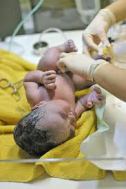
Problem:  Misidentification errors of NICU babies are common newborn3(Gray et al., 2006).   About 12% of the 4 million born in U.S. hospitals were admitted to NICU’s.  At birth every infant requires quick application of an armband, and when parents have not yet decided on a name the assigned name is often quite nondistinct (e.g., BabySmith).

Evidence:
A pretest/posttest of a new, more infant-specific naming system was “conducted in order to examine the effect of a distinct naming convention that incorporates the mother’s first name into the newborn’s first name (e.g., Wendysgirl) on the incidence of wrong-patient errors. We used the Retract-and-Reorder (RAR) tool, an established, automated tool for detecting the outcome of wrong-patient electronic orders. The RAR tool identifies orders placed on a patient that are retracted within 10 minutes and then placed by the same clinician on a different patient within the next 10 minutes” (Adelman et al., 2013). newborn2Their results? RAR events were reduced by 36.3%.   Their recommendations? Switch to a distinct naming system.

Using something like Judysgirl Smith is infant specific. “In the case of multiple births, the hospital adds a number in front of the mother’s first name (ex: 1Judysgirl and 2Judysgirl)” (TJC).

TJC recommends:

  • “Stop using Babyboy or Babygirl as part of the temporary name.
  • Change to a more distinct naming convention.
  • Train staff on the distinct naming convention.
  • Follow the recommendation in National Patient Safety Goal 01.01.01 and implement use of two patient identifiers at all times.
  • As soon as parents decide on their baby’s name, enter that name into the medical record instead of the temporary name.”

Commentary: While this is just one study, RNs should evaluate whether it is riskier to continue any current practice of non-distinct naming or to switch practices to distinct naming. No risks were identified to the distinct naming system & it likely requires only the resource investment of educating staff.  Adelman et al.’s (2013) study is current, moderately strong, quasi-experimental evidence that showed a significant decrease in errors that could have sentinel event outcomes. Any who make the switch should monitor outcomes. All who don’t make the switch should, too!

Critical Thinking: Examine the risks, resources, & readiness of staff in your facility to make the switch to a distinct NICU infant naming system?  question Should the naming system be extended to all infants?

Want more information?  See

Don’t Just Wish Upon Falling Stars: Take Evidence-based Action

The Joint Commission (TJC) published, Preventing falls and fall-related injuries in health care facilities, a new Sentinel Alert #55 on September 28, 2015 at http://www.jointcommission.org/assets/1/18/SEA_55.pdf

What’s the problem? Falls with serious injuries are among the top 10 events reported to TJC.   Analysis of that data shows that contributing factors are related to:

  • Inadequate assessment
  • Communication failures
  • Lack of adherence to protocols and safety practices
  • Inadequate staff orientation, supervision, staffing levels or skill mix
  • Deficiencies in the physical environment
  • Lack of leadership (page 1)

What to do?   Here are TJC recommendationsAction Plan

  1. Raise awareness of falls resulting in injury
  2. Establish an interprofessional falls committee
  3. Use a reliable, valid risk assessment tool
  4. Use EBP
    1. Standardized handoff including risk for falls
    2. One-to-one, bedside education of patients (& families?)
  5. Conduct post-fall management, which includes: a post-fall huddle; a system of honest, transparent reporting; trending and analysis of falls which can inform improvement efforts; and reassess the patient (page 2)

questionCritical thinking:  How would you apply AHRQ toolkit: Preventing Falls in Hospitals to your unit.

Want more info?   For tools, resources, & more details on above, see Joint Commission (2015, September 28). Preventing falls and fall-related injuries in health care facilities, Sentinel Event Alert, Issue 55.  Retrieved from Joint http://www.jointcommission.org/assets/1/18/SEA_55.pdf

“What was the question, again?” Hypothesis vs. Research question

imagesCAGYW6WBWhat is the difference between a hypothesis and a research question?  I suppose some will ask: “Why should I care?”  

The answer is that knowing the difference is a clue to how strong the research findings are.  Experimental studies that use hypothesis create stronger evidence for practice, than do non-experimental studies that merely answer research questions.

  • hypothesis is a predicted answer and focuses on cause-and-effect , such as “Those who take 80mg ASA every day will have lower incidence of MI’s than those who do not.”  When we know a lot about a topic already, then we can hypothesize (in other words make an educated guess about how the experiment will turn out).  A researcher may word the hypothesis in interrogative form with a question mark, but you can still recognize it as a hypothesis if it uses any terms like cause, effect, impact, increase, improve, or their synonyms and has at least 2 variables.
  • Researchers ask only a research question when they don’t know enough to guess about the cause and effect, & so they either 1) want merely to describe something or 2) to figure out whether 2 things are related to each other, but aren’t ready to identify one as causing the other. For example no one knows which came 1st, the chicken or the egg?—you can see that chickens and eggs are related 100% of the time, but you may win a Nobel prize if you can figure out which one originally caused the other.

Cause and effect (experimental, hypothesis) studies create stronger evidence for practice than do descriptive or correlational (non-experimental, question) studies.

Critical thinking question: One of the following is a hypothesis & one is a research question.  Which is wquestionhich and why?

  1.  The purpose of this study was to describe the expectations for pain relief of patients with abdominal pain and how their communication with providers relates to their overall pain relief. (Yee et al 2006)
  2.  We investigated whether a brief pain communication/education strategy would improve patient pain communication skills. (Smith et al, 2010)

“When Science Meets Sacred Cows”

Sometimes the scientific evidence is clear….but no one wants to change what they are doing.

Change is hard if providers, media, or members of the public are in love with keeping things the way they are, or have a vested interest in the status quo, or perhaps just don’t like change…or the evidence.  (Maybe we’re all a little guilty of this.)cow nosw

Check out this free, full-text editorial available through PubMed: http://www.o-wm.com/content/when-science-meets-sacred-cows  (Source: 2010 OWM).

Critical Thinking: What sacred cows should be put out to pasture in your or others’ practice?  What about using the Trendeleberg position to treat hypotension, checking foley balloons before insertion, other?  List a few areas where your organization HAS changed practice based on evidence.  What were the barriers & facilitators?

“I wonder as I wander…. ” DNP or PhD? What’s the diff?

Ever wonder what the difference is between the new Doctorate of Nursing Practice (DNP) and the Doctorate of Philosophy in nursing (PhD)?      examine baby

In short the focus of PhD education is to prepare the RN to create original research.  In contrast, DNP education is to prepare the RN to apply existing research to nursing practice.

Being a nurse practitioner (NP) is NOT the difference.  Also while some PhDs become skilled in applying research to practice & some DNPs do research,…their doctoral course preparation & final projects are quite different!

For more information:  Here’s a great comparison chart from one doctoral program:  https://nursingandhealth.asu.edu/degree-programs/doctoral-vs-phd-degrees-at-asu

Critical reflection: Based on your own personal career goals….questionIf you were to return for a doctorate, which would you find most useful?

METHODS in the Research Madness

[This is a re-post from 2014.  If you weren’t a reader then….read on…..]

fisheye booksResearch article sections are: Title, Abstract, Introduction/background,Methods, Results, Discussion, & Implications/Conclusions

METHODS =  Design, Sample, Setting, & Data collection instrument

Sometimes these above elements of METHODS are subheadings.

Sometimes not.

  • Key point #1: Design= overall plan for answering the question or proving the hypothesis.  KEYThe 2 basic types of design are 1) experimental & 2) non-experimental.   In experimental, the researcher does something to the subjects and measures the effects of that something.  In non-experimental, the research merely observes and describes what is happening without doing anything to change it.

  •  KEYKey point #2: Setting=where the study is conducted: home, hospital, office, classroom, on KEYan ocean cruise, or other.
  • Key point #3: Sample includes who/what subjects were in & excluded from the study; how many subjects were in the study; & whether subjects were selected using random methods or non-random methods.   In random selection every eligible subject has the same chance of being selected. That’s called probability sampling.  An example is drawing names from a hat.  In non-random selection only the most nearby subjects are asked to be in the study. That’s called non-probability or convenience sampling.  An example, using a clipboard to survey people who walk into a mall one day. [Note: Subjects can be people, animals, charts, hospitals, or nations.]

(Whew!….Enough for now.)

Critical Thinking Exercise:  Find the Design, Setting, & Sample in this excerpt of Methods from Mohammedkarimi et al, (2014): question

“A double-blind, randomized clinical trial (RCT) was performed among 90 adult patients with acute headache in Shahid Rahnemoon Emergency Center of Yazd city of Iran (45 patients in lidocaine group and 45 patients in placebo group). Patients with history of epilepsy, allergy to lidocaine, signs of skull base fracture, Glasgow Coma Scale (GCS) < 15, patients younger than 14 years and patients who had received any medication in previous 2 h were excluded.”

Introduction to Introductions!

I have a lot of new readers, so let’s revisit the standard sections of a research article.  They are:

  • Introduction (or Background)
  • Review of literature
  • Methods
  • Results (or findings)
  • Discussion & Implications
  • Conclusion

If we begin at the beginning, then we should ask: “What’s in an Introduction?”  Here’s the answer:

“[a] …Background of the problem or issue being examined,

[b] …Existing literature on the subject, and

[c] …Research questions, objectives, and possibly hypothesis” (p. 6, Davies & Logan, 2012)

This is the very 1st section of the body of the research article.  In it you will find a description of the problem that the researcher is studying, why the problem is a priority, and sometimes what is already known about the problem.  The description of what is already known may or may not be labelled separately as a Review of Literature.

KEYKey point #1: Articles & research that are reviewed in the Intro/Background should be mostly within the past 5-7 years.  Sometimes included are classic works that may be much older OR sometimes no recent research exists.   If recent articles aren’t used, this should raise some questions in your mind.   You know well that healthcare changes all the time!!  If there are no recent studies the author should explain.

KEY
Key point #2The last sentence or two in the Intro/Background is the research question or hypothesis.  If you need to know the research question/hypothesis right away, you can skip straight to the end of the Intro/background—and there it should be!

Happy research reading!

Critical Thinking: Do the sections of the abstract AND the sections of the research article match above headings?  Does it match the description of Introduction? Take a look at the free article by Kennedy et al. (2014). Is there a relationship between personality and choice of nursing specialty: An integrative literature, BMC Nursing, 13(40). Retrieved from the link http://www.ncbi.nlm.nih.gov/pmc/articles/PMC4267136/.  question


A 33,000 foot view: The Abstract

 Abstracts are great; abstracts are not enough!
An abstract will not give you enough information to accurately apply the study findings to practice.   An abstract typically summarizes all the other sections of the article, such as  the question the researcher wanted to answer, how the researcher collected data to answer it, and what that data showed.  This is great when you are trying to get the general picture, but you should Never assume that the abstract tells you what you need to know.
airplaneWingIsland
Abstracts can mislead you IF you do not read the rest of the article.  They are only a short 100-200 words and so the authors have to leave out key information.   You may misunderstand study results if you read only the abstract.   An abstract’s 33,000 foot level FootprintsInSand
description of a study, cannot reveal the same things that you can learn from an up-close look at details.  You want to know exactly who was in the study, exactly what the researcher did, & exactly how outcomes were measured!  You want to follow the researcher’s footprints up close, not just do a fly-over.
So…what is the takeaway?  Definitely read the abstract to get the general idea.  Then read the article beginning to end.  Don’t give up reading the full article just because some parts of the study may be hard to understand.  Just read and get what you can. Then try a re-read or get some help understanding any difficult sections.   This is an important step toward EBP.   [revised from my former blogsite]
Critical thinking:  What info is missing from this abstract at this link that you would want to know before using the findings of this pain study to practice?
http://www.ncbi.nlm.nih.gov/pubmed/25659796QUESTION

Finding the Needles in the Haystacks: Evidence Hunting Efficiently & Effectively

Searching for the right evidence is an art & a science.   In an effective search, the RN: twoOnComputer

  1. Identifies excellent key words based on a clear problem statement
  2. Systematically searches the best databases for those words
  3. Keeps a record of the search strategy.

This is actually a pretty simple time-saver because it keeps you from having to repeat searches because you can’t remember where you looked!!

Let’s take an example that we used previously.  Here’s how it was laid out in PICO (which stands for Population/problem, Intervention, Comparison intervention, & Outcome)

  • Population/problem= Postoperative patients with ileus (Patient population &Problem)
  • Intervention= Gum chewing postop (Intervention to try out)
  • Comparison intervention= NPO with gradual diet progression when bowel sounds start returning
  • Outcome= Reduce time of postop ileus with sooner return to nutritious eating

We would:magnifyingGlass

  1. Using PICO, identify key concepts (words), such as “postoperative ileus” “gum chewing” and “NPO.” Note that you can pick single words or combinations of words.
  2. Search for this set of words in the very comprehensive databases of PubMed and also in CINAHL. CINAHL is more nursing specific, and PubMed is one of the most comprehensive out there. Search from MOST RECENT to earlier.  Go for only most recent 5 years unless 5 years doesn’t give you enough articles.
  3. Keep notes of exactly which words and phrases you used to search each database

This 5 minute video shows you a GREAT way to make sure that your search is complete with minimal effort. It’s an easy-peasy tracking strategy for where you’ve already looked. https://www.youtube.com/watch?v=233DzkmimV4&list=PLE3A977BE32CF3956

CRITICAL THINKING: What are the key words of your clinical problem of interest.  (You can choose to use PICO or not.)  Plug them into PubMed.  Did you get enough articles?QUESTION

Making research accessible to RNs