[note: bonus 20% book discount from publisher. See below flyer]
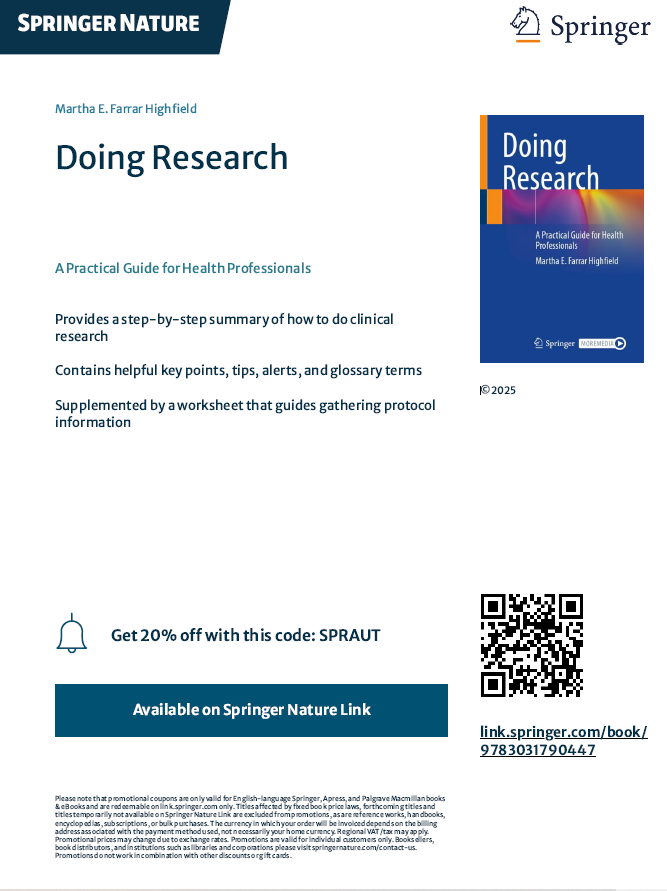
My 2025 book, Doing Research, is a user-friendly guide, not a comprehensive text. Chapter 1 gives a dozen tips to get started, Chapter 2 defines research, and Chapters 3-9 focus on planning. The remaining Chapters 10-12 guide you through challenges of conducting a study, getting answers from the data, and sharing with others what you learned. Italicized key terms are defined in the glossary, and a bibliography lists additional resources.
AI is getting better at 1) organizing information & 2) making suggestions for planning and writing research.
1st—a word of warning: Always verify AI-generated contentUSING YOUR OWN KNOWLEDGE!!Otherwise you’ll likely have AI hallucinations–content that is wrong, deceptive, or just plain nonsense. Scary!
Marek Kiczkowiak (speaker in below video) gives the AI-research-assistant gold medal to SCISPACE. AI SCISPACE bills itself as “The Fastest Research Platform Ever: All-in-one AI tools for students and researchers.” It performs a host of tasks, including creating slides from your paper. Other AI tools, like jenni or ResearchRabbit do some things better or differently. Watch this informative video, & try the tools.
What ethics questions does this raise? Two are: 1) questions of plagiarism (stealing) and 2) questions of how much YOU are learning when being AI-assisted.
Publishers are beginning to ask authors to what extent (if any) AI was used in a submitted paper. Moreoever, caution about plagiarizing is a cheap price for a clean conscience & learning what you need to learn. Hang onto those outcomes. “Above all else, guard your heart, for everything you do flows from it” -Proverb 4:23.
Here’s a second video for some help on avoiding plagiarism.
Your thots?
———————————————————–
Also, check out my 2025 bookDoing Research (~100pp) that is written to help make the difficult simple.
[Best place to purchase now is this link: Springer. Amazon is stocking it erratically for reasons mysterious to the publisher.]
Do you love historical research and wish you could read more?
Check out the 1-hour reads at Hourly History. A short biography of Florence Nightingale is among their reads. You can also sign up for free e-reads.
And remember…nursing & health history never happened (or happen) in a vacuum. Understanding the larger political, medical, geographical, adventurer, ideological, musical, art, philosophical, religious, cultural history (milieu) of any era is important, and these books can give quick insights. For example, Crimean or British leadership during Nightingale’s time will help you understand her and her contributions.
Check out one or more of these books, and let me know what you think. -DrH
Disclaimer: I have no financial or other interest in the Hourly History site or the books it promotes; and I cannot speak to their historical quality.
This book provides a step-by-step summary of how to do clinical research. It explains what research is and isn’t, where to begin and end, and the meaning of key terms. A project planning worksheet is included and can be used as readers work their way through the book in developing a research protocol. The purpose of this book is to empower curious clinicians who want data-based answers.
Doing Research is a concise, user-friendly guide to conducting research, rather than a comprehensive research text. The book contains 12 main chapters followed by the protocol worksheet. Chapter 1 offers a dozen tips to get started, Chapter 2 defines research, and Chapters 3-9 focus on planning. Chapters 10-12 then guide readers through challenges of conducting a study, getting answers from the data, and disseminating results. Useful key points, tips, and alerts are strewn throughout the book to advise and encourage readers.
Writing out your clinical question using the acronym PICOT may be different depending on whether you are planning to
do research (fill gaps in our knowledge) or
find & use best evidence in practice (EBP/evidence-based practice).
PICOT stands for Population, Intervention, Comparison intervention, Outcome to be measured, and Timing of the measurement. The reason that PICOT is sometimes written a bit differently for research than for EBP projects is that PICOT is used to generate the most helpful literature search terms.
RESEARCH vs. EBPPICOT-—
In research you may be testing a very specific intervention because available evidence allows you to predict what intervention might be helpful. That means you want to specify the particular intervention (I) in which you are interested.
In EBP you may want to find out if an effective intervention for the problem already exists? And if so, what is it? That means when writing PICOT, you should NOT specify the I (intervention). Identify the P (population) and O (desired outcome), but for I (intervention) use a general term like “methods,” “techniques,” “strategies,” and so on. This will give you a richer overview of what others tested already. [Note: If you are finding literature that suggests a particular intervention is most effective, you might decide to insert that particular intervention in your PICOT and hence in your search terms.]
PRACTICE: Pick a clinical problem that is bugging you and try out an EBP PICOT vs a research PICOT. Compare results.
Want to know the standardized format for writing up your research study, QI report, case study, systematic review, or clinical practice guideline? Check out these standardized reporting guidelines: http://www.equator-network.org/reporting-guidelines/
Of course you should always give priority to the author instructions for the particular journal in which you want to publish, but most adhere generally or fully to these standardized guides.
Want to know how to write an introduction/background section of a paper? Pay attention to STRUCTURE & evidence-based ARGUMENT in order to DIY (do-it-yourself) your own intro/background for a school paper or research report!
Focus only on the INTRO/BACKGROUND section for now. Check out the STRUCTURE then the EVIDENCE-BASED ARGUMENT of the Intro/Background. This is how you should write your own.
STRUCTURE of INTRO/BACKGROUND in Sørbø et al. (2015):
Where is the Intro/Background section located in the article?
What heading is used for the section?
Where are the research questionslocated in the Intro/Background? (HINT: this is the standard place in all papers & in this case the authors call them “aims.)
ARGUMENTS in INTRO/BACKGROUND in Sørbø et al. (2015):
Look at the first (topic) sentence of each paragraph in INTRO/BACKGROUND & listen to the systematic argument the researchers are making for WHY their study is important.
“Breast feeding has long been acknowledged as the optimal infant nutrition conferring beneficial short-term and long-term health effects for both infants and mothers.1–5 …
Abuse of women is common worldwide, as one in three women during lifetime suffer partner or non-partner abuse.10…Adverse effects [of abuse]… are barriers to breast feeding.*…
Given the overwhelming evidence of the positive effects of breast feeding, knowledge about factors influencing breastfeeding behaviour is essential….
We explored the impact of abuse of women on breastfeeding behaviour in a large prospective population in Norway where the expectations to breast feed are high, and breast feeding is facilitated in the work regulations….” (pp. 1-2)
Now look at the research & other evidence written down AFTER each of above key sentences that SUPPORT each idea.
Notice that the INTRO/BACKGROUND is NOT a series of abstracts of different studies!! Instead evidence is grouped into key arguments for the study: Breast feeding is best, Abuse is common, Abuse creates barriers to breastfeeding, & Therefore, knowing about factors affecting breastfeeding is important). [Note: Of course, if your particular professor or editor asks you to do a series of abstracts, then you must, but do group them in arguments like the topic sentences.]
All this leads naturally, logically to …(drum roll please!)…the research questions/hypotheses, which are the gaps in our knowledge that the research will fill. This sets up the rest of the research article!
Critical Thinking: Your turn! Write your own Intro/Background using
Structure:Placement in article, heading, placement of research question/hypothesis
Argument:Key idea topic sentences (make a list 1st) with supporting research & other evidence (your literature review).
Don’t be fooled. It’s a lot of work to prepare something to publish, and you want your work to appear in a credible source and be accessible. It’s YOUR reputation!
If you are a student search for literature, it is important to know this also!! You want to use the highest quality evidence you can find for your projects.
How strong is the evidence regarding our holiday Santa Claus (SC) practices? And what are the opportunities on this SC topic for new descriptive, correlation, or experimental research? Although existing evidence generally supports SC, in the end we may conclude, “the most real things in the world are those that neither children nor men can see” (Church, as cited in Newseum, n.d.).
Critical thinking: Check out this related research study with fulltext available through PubMed: Black Pete through the eyes of Dutch children
(https://www.ncbi.nlm.nih.gov/pubmed/27322583 ). Write a follow-up research question based on the findings of this study & post in comments below.
For more info: For those unfamiliar with ResearchGate, it is a site where you can track authors who publish in your area of interest, and you can set up your own profile so that people can track your work. Take a look.








 case study, systematic review, or clinical practice guideline? Check out these standardized reporting guidelines: